Research · Publication & note
Silicon Microresonators: How to Give a New Twist to Silicon Photonics - Notes

BOOK CHAPTER
Article summary
This book chapter presents silicon microresonators as versatile building blocks for integrated photonics. It moves from disk, ring and racetrack cavities to interferometric switching, chaotic dynamics in coupled-resonator sequences, vertically coupled wedge resonators, thermo-optical bistability and reactive intermode coupling. The final sections examine label-free biosensing and optomechanics, combining coupled-mode models, microfabrication, transmission measurements and finite-element simulations.
Chapter scope
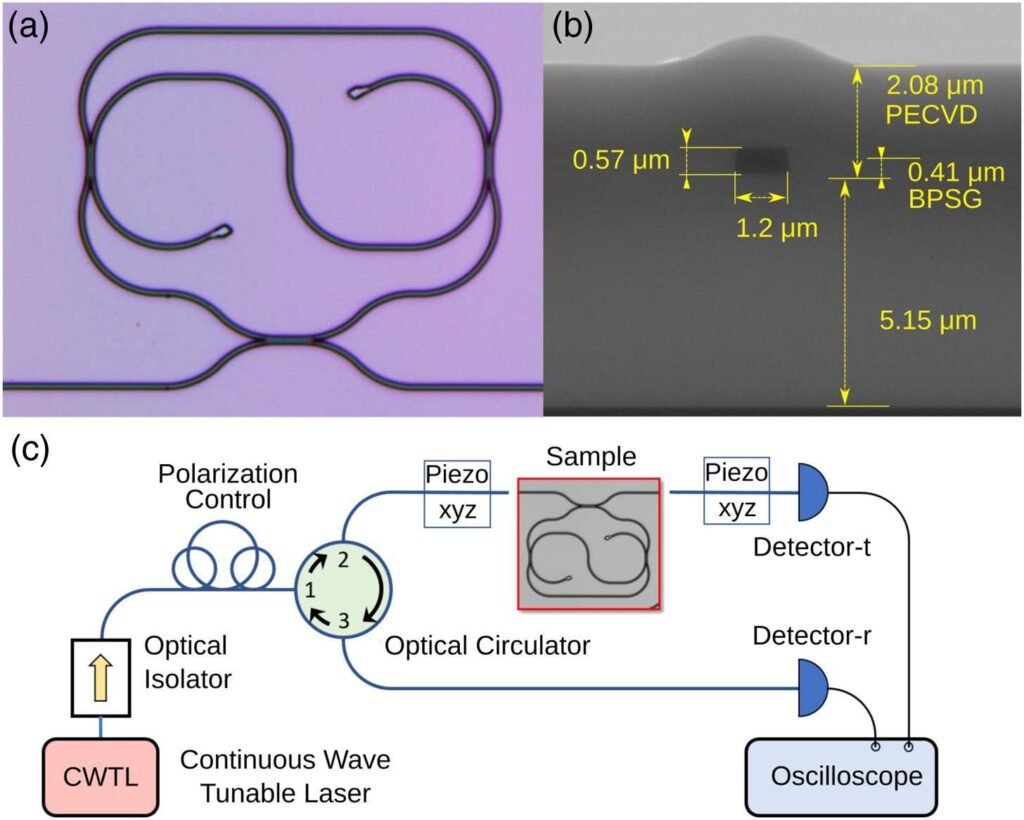
The chapter treats a microresonator as a repeatable functional element rather than a single-purpose filter. Phase-controlled ring-enhanced interferometers provide three routing states; nonlinear SCISSOR chains generate self-pulsing and chaotic signals that can seed optical random-bit streams; and a vertical architecture separates the resonator from its buried waveguide so that materials, geometry and coupling can be engineered independently. This same platform is then extended to label-free biosensing and optomechanics, where optical, thermal and mechanical degrees of freedom interact within one integrated device.
Article access and reuse
The DOI link opens the official SPIE Press record for this chapter. The locally supplied publisher-formatted PDF is not hosted here, and no figures are separately reproduced, because the applicable author-reuse permission has not been independently verified. This page therefore provides original editorial context, bibliographic metadata and links to the publisher’s record.
Related publications



Research fields
Top-down
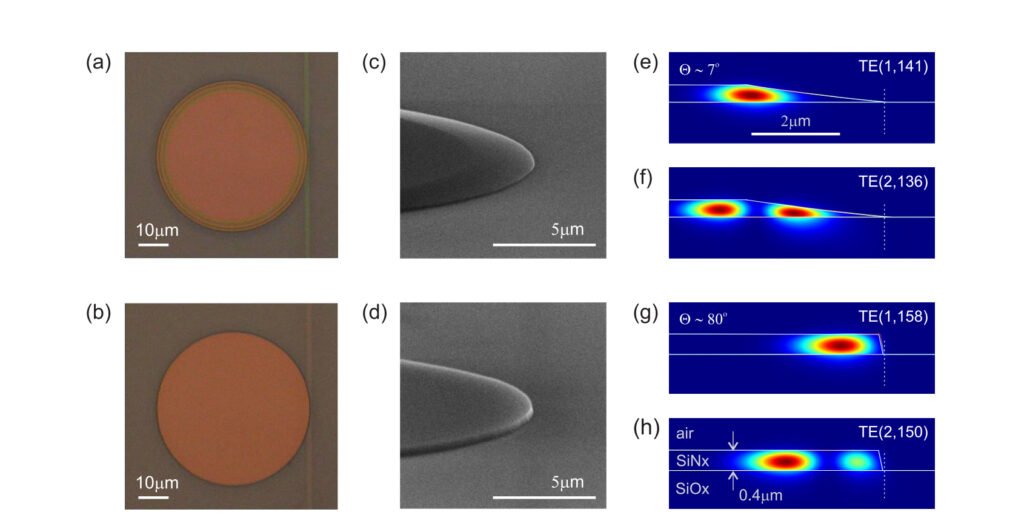
The chapter follows the lithographic fabrication of silicon-compatible disks, rings, racetracks and wedge resonators together with their bus waveguides. In the vertically coupled platform, SiON or SiN waveguides are buried beneath a planarized BPSG cladding before the resonator is defined in a separate step. This separates the optical materials and coupling geometry, while the wedge profile moves the fundamental mode away from the rough outer edge and raises the measured quality factor from about 9 × 10³ for a dry-etched disk to 3.5 × 10⁴ for the wedge device.
Simulations & fits
Coupled-mode and transfer-matrix models connect phase, attenuation, resonance splitting and transmission in add-drop, CROW, SCISSOR and vertically coupled geometries. The analysis also uses Lyapunov exponents to identify chaotic regimes in coupled rings, Lorentzian fits to obtain cavity quality factors, and finite-element models that combine optical, thermal and mechanical modes when evaluating biosensors and optomechanical devices.
Characterization
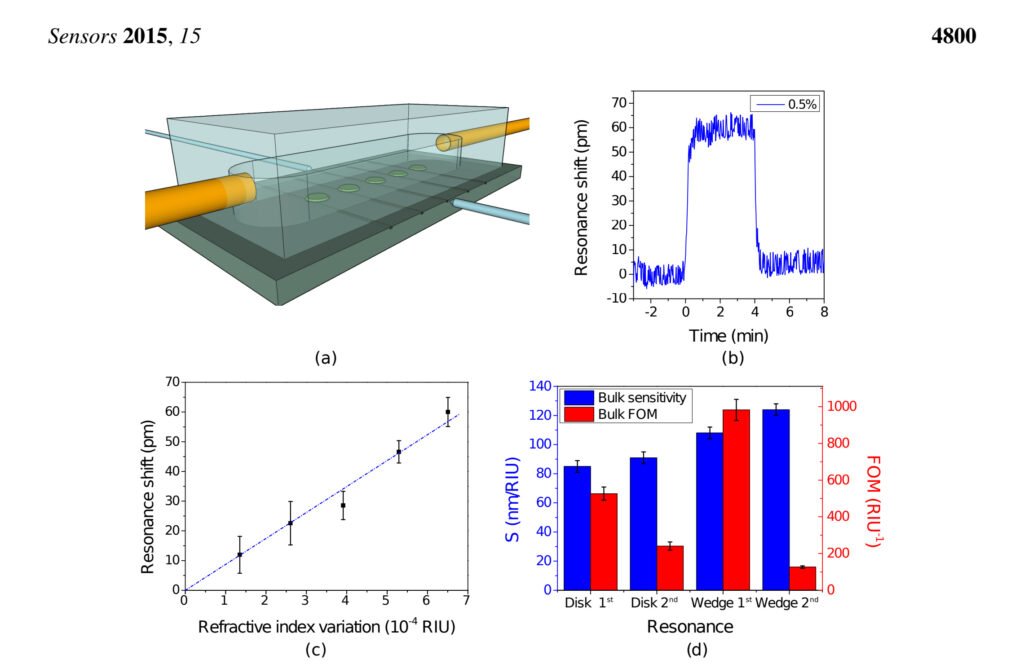
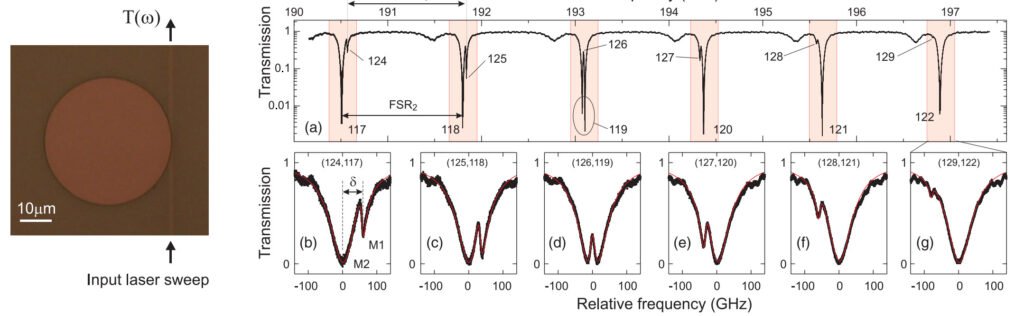
Transmission spectra are used throughout the chapter to distinguish critical, under- and overcoupling, quantify quality factors and follow thermo-optical hysteresis. Time-resolved measurements characterize chaotic outputs and optical random-bit generation, while microfluidic sensorgrams separate bulk-index changes from specific thrombin binding. These experiments connect fabrication and modelling to the actual switching, sensing and nonlinear response of the resonators.
Research topics
 ResonatorsDisks, rings, racetracks and wedge cavities are treated through their free spectral range, intrinsic and coupling losses, mode volume and quality factor. The chapter uses these quantities to connect cavity geometry with switching, nonlinear enhancement, sensing resolution and optomechanical actuation rather than presenting the resonator as a single-purpose component.
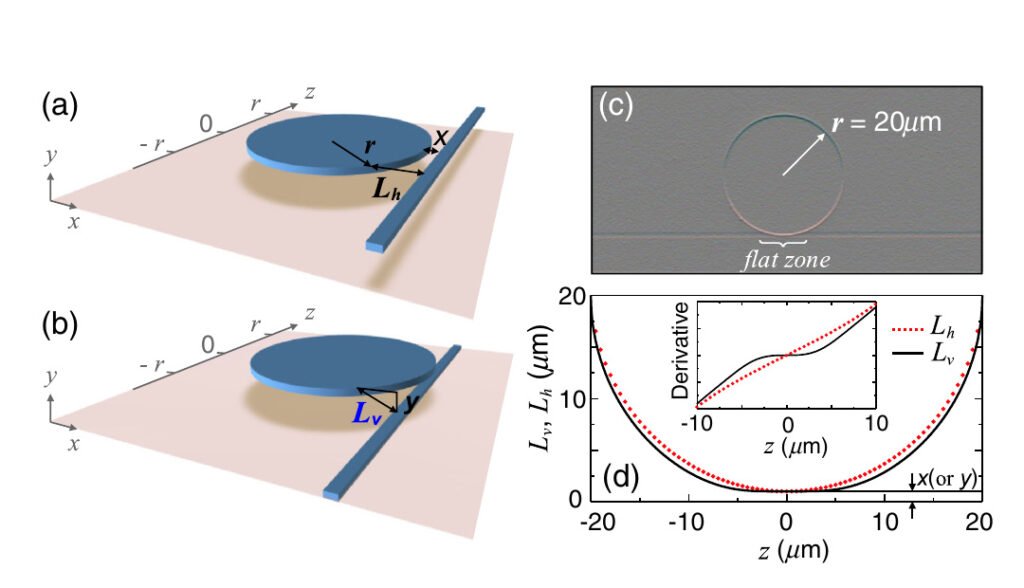
 CouplingThe comparison between lateral and vertical evanescent coupling is central to the chapter. The same framework explains reactive intermode coupling and the associated Fano line shapes.
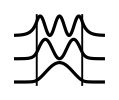 InterferencePhase is used as an active routing variable in ring-enhanced Mach-Zehnder structures. The band positions depend mainly on inter-resonator coupling, improving tolerance to radius errors.
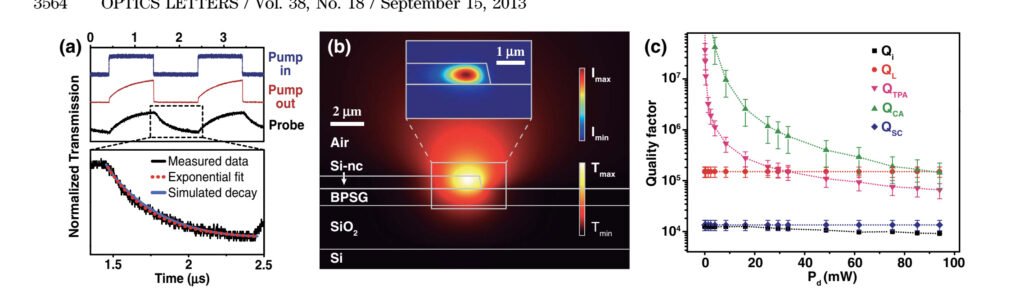
 NonlinearThermal and free-carrier nonlinearities drive self-pulsing and chaos in SCISSOR sequences under continuous-wave excitation. A separate vertically coupled Si-nanocrystal microdisk demonstrates thermo-optical bistability through two distinct switching thresholds.
 SetupsThe experimental platforms combine fibre or butt coupling, tunable near-infrared lasers, buried waveguides and transmission detection with nanofabricated cavities. For biosensing, microfluidics deliver analytes to functionalized microrings and reference resonators enable differential measurements.
 MaterialsSilicon provides the high-index, CMOS-compatible base platform, while SiON and SiN waveguides, BPSG planarization layers and Si-nanocrystal-loaded resonators supply functions that bulk silicon alone cannot provide. Assigning different materials to the cavity and buried waveguide is one of the main advantages of the vertical architecture and allows optical loss, nonlinearity and mechanical compliance to be engineered separately.