Research · Publication & note
Role of Edge Inclination in an Optical Microdisk Resonator for Label-Free Sensing - Notes
Sensors · Journal article · 26 February 2015
Published abstract
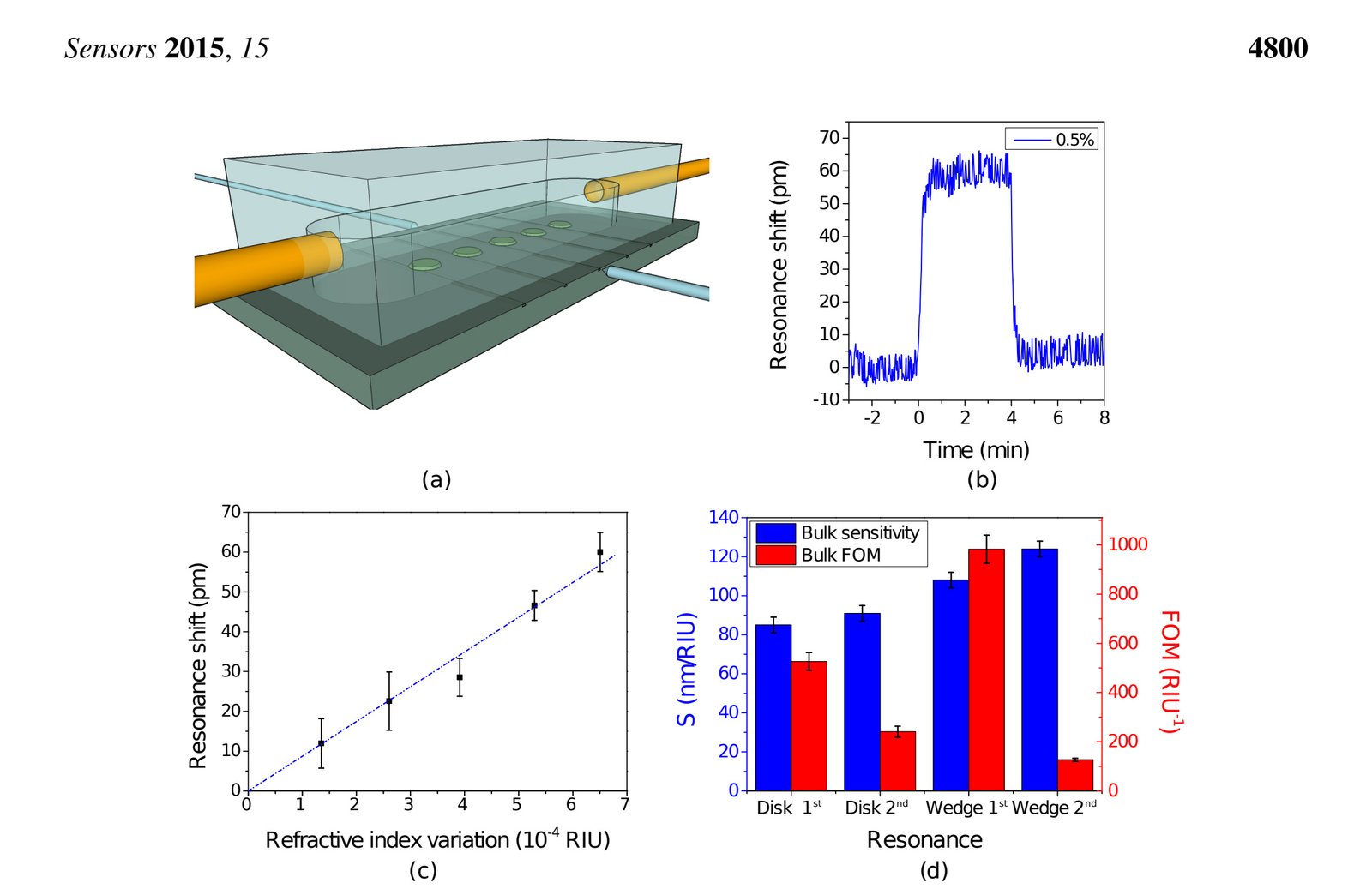
In this paper, we report on the measurement and modeling of enhanced optical refractometric sensors based on whispering gallery modes. The devices under test are optical microresonators made of silicon nitride on silicon oxide, which differ in their sidewall inclination angle. In our approach, these microresonators are vertically coupled to a buried waveguide with the aim of creating integrated and cost-effective devices. Device modeling shows that the optimization of the device is a delicate balance of the resonance quality factor and evanescent field overlap with the surrounding environment to analyze. By numerical simulations, we show that the microdisk thickness is critical to yield a high figure of merit for the sensor and that edge inclination should be kept as high as possible. We also show that bulk-sensing figures of merit as high as 1600 RIU⁻¹ (refractive index unit) are feasible.
Figures
From D. Gandolfi et al., Sensors 15(3), 4796-4809 (2015), DOI 10.3390/s150304796. © 2015 The Authors. CC BY 4.0.
From D. Gandolfi et al., Sensors 15(3), 4796-4809 (2015), DOI 10.3390/s150304796. © 2015 The Authors. CC BY 4.0.
How to cite
Article access and reuse
This is an open-access article distributed under the Creative Commons Attribution licence. The article and its figures may be shared and adapted provided that the authors, source and licence are credited and any changes are indicated. The two original figures below are reproduced from the article without reconstruction.
Related publications



Research fields
Top-down
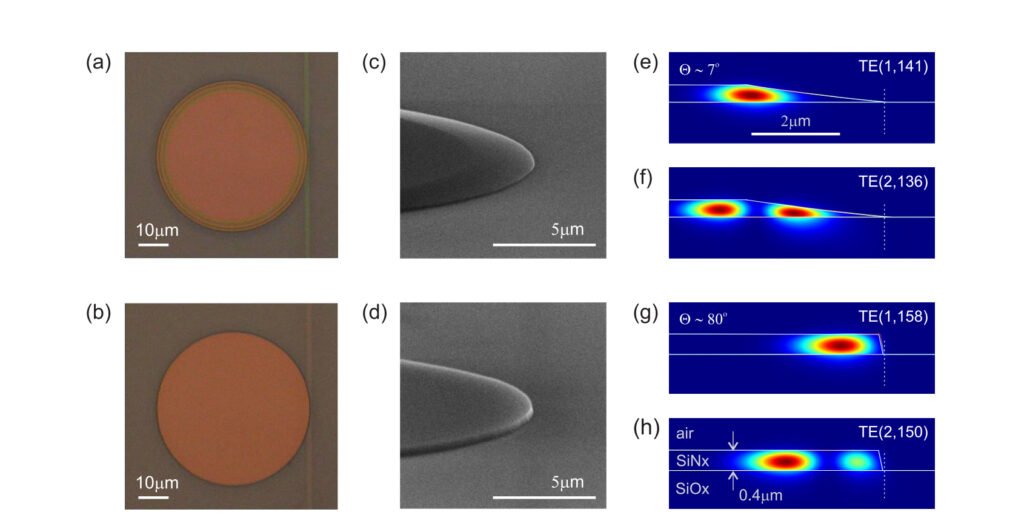
Vertically coupled silicon-nitride microdisks and wedges are fabricated with deliberately different sidewall inclinations and integrated beneath a microfluidic cell. Edge geometry becomes a design parameter that trades optical confinement against analyte overlap.
Simulations & fits
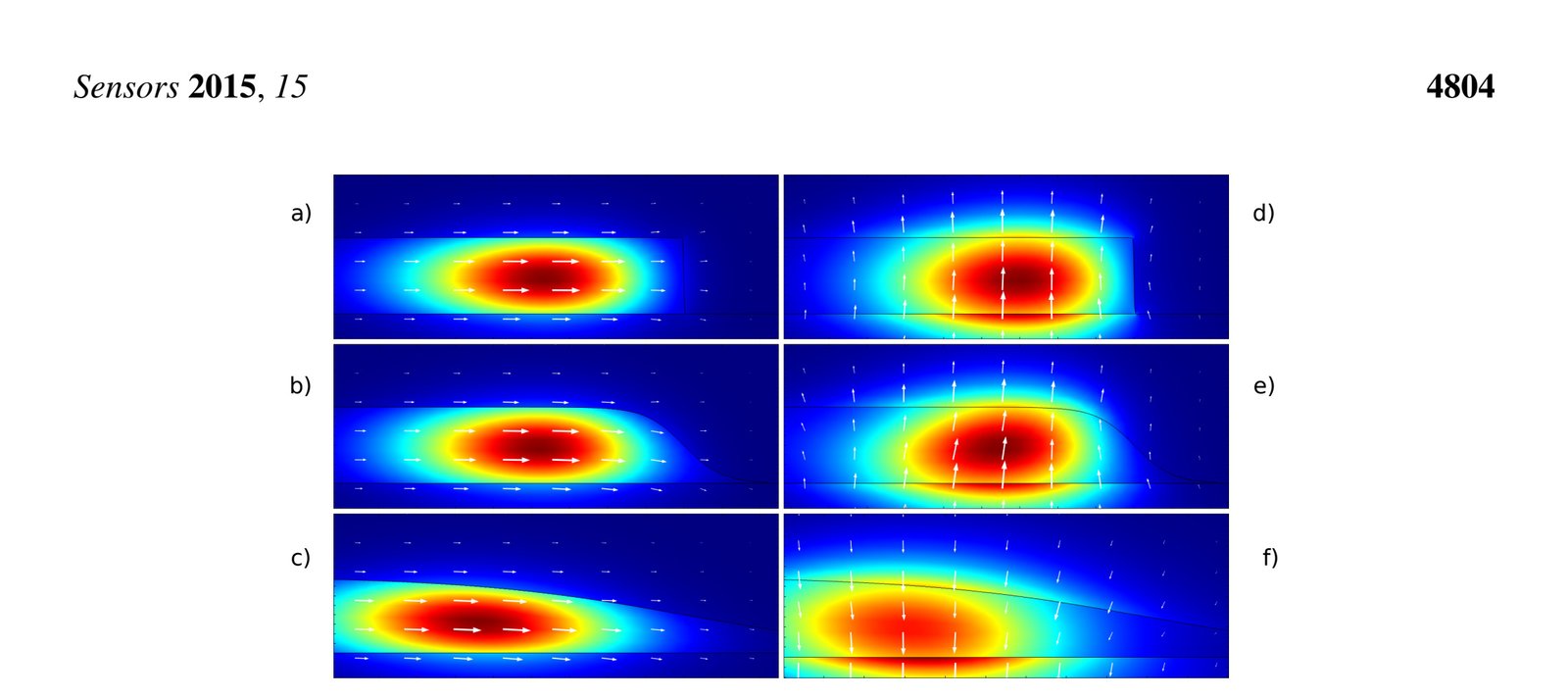
Finite-element mode calculations sweep wedge angle, thickness and polarisation to evaluate quality factor and evanescent-field sensitivity. The model explains why a less confined mode may still produce a better refractometric figure of merit when its radiation loss remains controlled.
Characterization
Liquids of known refractive index are delivered over the resonators while wavelength shifts and linewidths are measured through the buried waveguide. Comparing nominally matched disks and wedges tests the predicted influence of sidewall angle in a label-free sensing experiment.
RESEARCH TOPICS
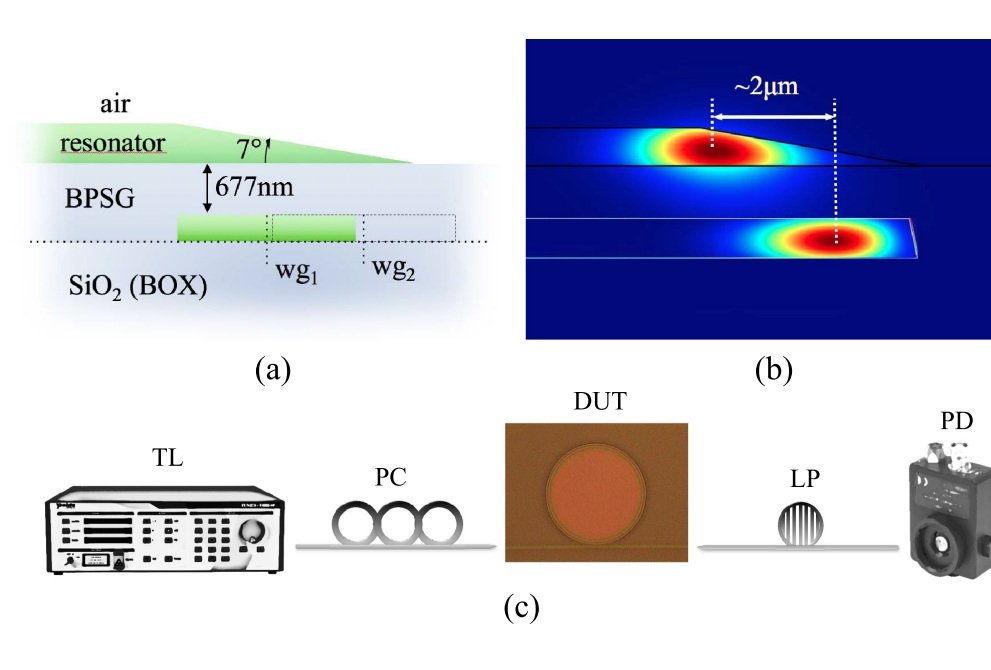
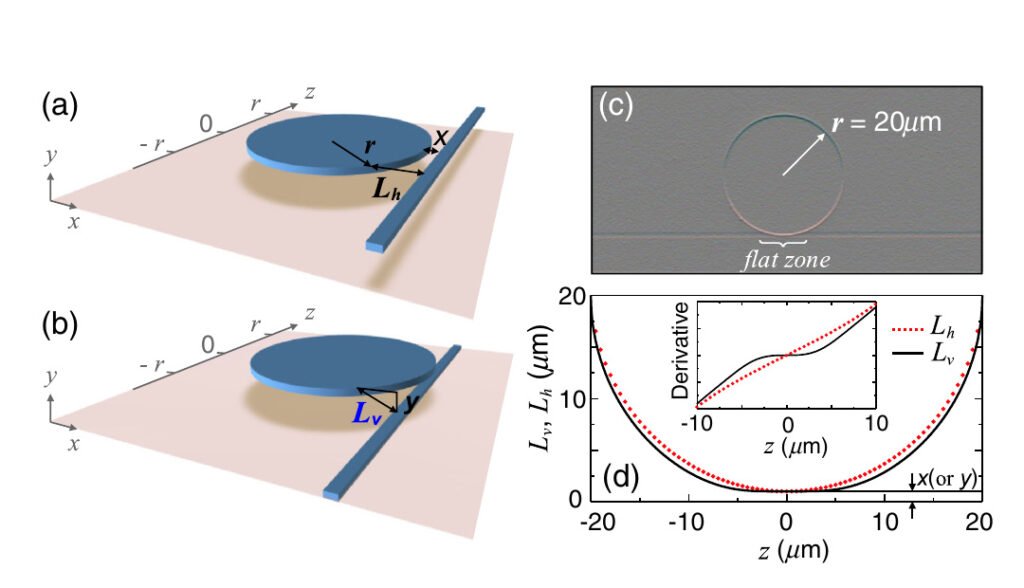
 CouplingThe SiNx disk sits above a buried BPSG waveguide, so optical loading is controlled vertically while the resonator sidewall remains exposed to the analyte. That separation is especially important for wedge sensors: the waveguide can address a mode retracted from the edge without occupying or perturbing the sensing surface.
 MaterialsThe sensing stack combines a silicon-nitride cavity, planarised borophosphosilicate-glass lower cladding and a water-like upper environment. The measured intrinsic Q of the wedge is about 28,000 near critical coupling and is interpreted as absorption-limited, not sidewall-scattering-limited.
 ResonatorsSimulations show that the edge inclination should remain above roughly 40°; shallower wedges lose useful confinement and Q even though they may increase field exposure. The result is therefore a design trade-off, not a simple rule that a sharper wedge is always more sensitive.