Research · Publication & note
Silicon-based monolithically integrated whispering-gallery mode resonators with buried waveguides - Notes

Research publication
Published abstract
We report on the realization and characterization of a silicon-based integrated optical platform which implements a vertical coupling scheme between a Whispering-gallery type microresonator and a buried dielectric waveguide. The vertical coupling allows for the separation of the resonator and the waveguide into different planes, which enables one to realize the optical components in different materials/thicknesses. The high optical quality of this cavity micro-optical system follows from the accurate planarization of the waveguide topography, which is achieved by multiple depositions-and-reflows of a borophosphosilicate glass over strip waveguides. Importantly, we demonstrate the feasibility of our approach for wafer-scale mass fabrication of freestanding planar resonators suspended in air and coupled to integrated bus waveguides. This opens the door for the realization of stable all-integrated resonator systems for optomechanical and metrological applications and has the potential to substitute today’s complicated fiber-taper coupling schemes.
How to cite
Article access and reuse
The available local PDF is the SPIE Version of Record and is not hosted. No figures are reproduced independently. The official article is linked through its DOI above. SPIE permits an author-prepared preprint or accepted manuscript to be posted under its web-posting conditions, but no such version has been identified for this entry.
Related publications

Research fields
Top-down
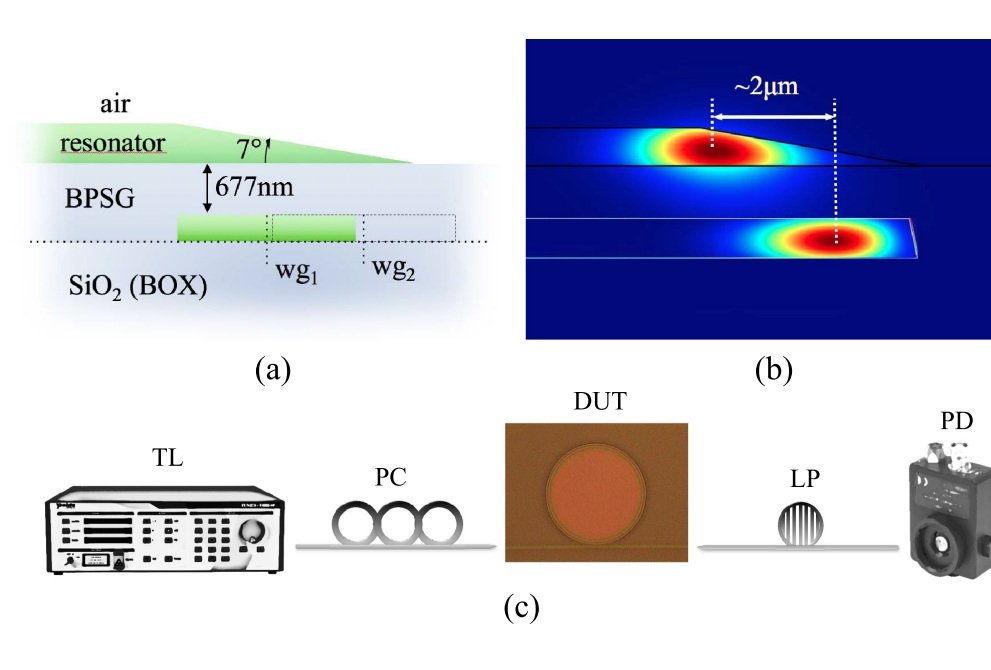
Wafer-scale processing forms freestanding planar resonators above buried dielectric bus waveguides. Repeated borophosphosilicate-glass deposition and reflow flatten the waveguide step before the cavity layer is defined and selectively suspended.
Simulations & fits
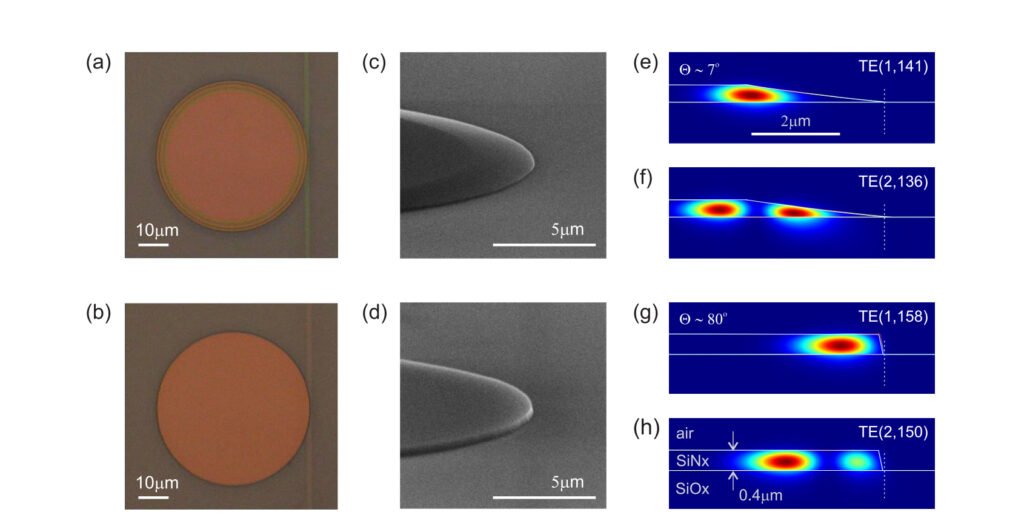
Finite-element mode profiles evaluate the vertically coupled cross-section and guide the separation needed for efficient interaction without compromising suspension. Resonance analysis then quantifies the performance of the first fabricated devices.
Characterization
Surface-profile measurements, optical microscopy and SEM validate planarisation and release before broadband waveguide transmission is recorded. The completed platform reaches quality factors around 15,000 and demonstrates repeatable integrated access to the suspended cavity.
RESEARCH TOPICS
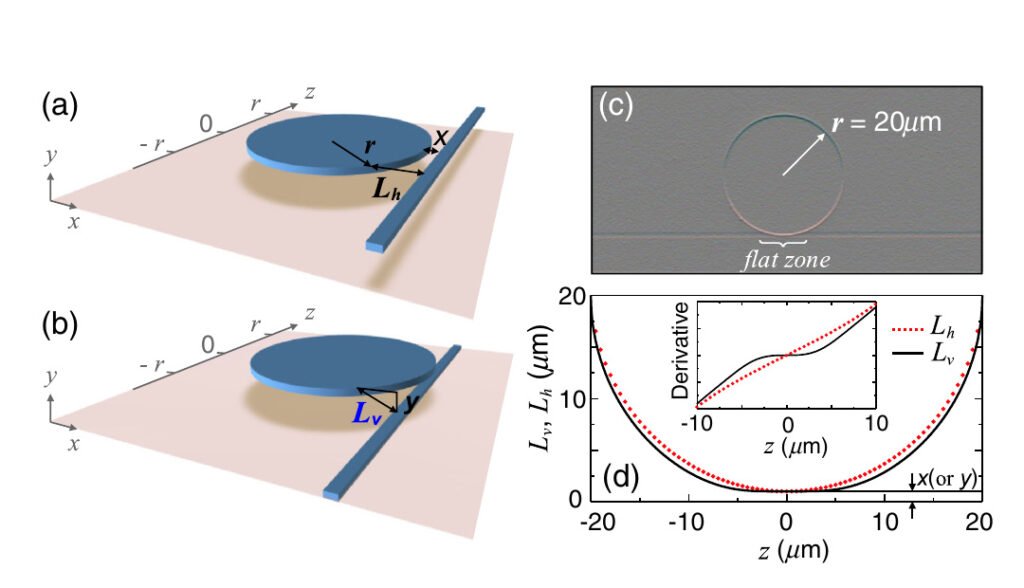
 CouplingVertical loading is set mainly by the deposited spacer rather than by a submicrometre lateral lithographic gap. This repeatable gap control is the practical advantage over manually positioned tapered fibres.
 MaterialsA 290 nm PECVD SiON layer is patterned into 2 μm buried strip guides, covered and planarised by repeated borophosphosilicate-glass deposition and reflow. An optional sacrificial layer permits air-suspended disks and spiderweb rings while the bus remains integrated below, demonstrating that the same silicon-compatible stack supports multiple mechanical and optical geometries.
 ResonatorsQ varies systematically with the vertical gap because the loaded linewidth combines intrinsic loss with controllable waveguide leakage. The platform is thus not simply an image of fabricated devices: its optical spectra demonstrate a stable, wafer-scale route to integrated WGM cavities whose loading can be designed before fabrication.