Research · Publication & note
Monolithic integration of high-Q wedge resonators with vertically coupled waveguides - Notes

Research publication
Published abstract
Typical UHQ resonators, microspheres and microtoroids, lack the possibility of integration into lightwave circuits due to their planarity constrains. In this context, CMOS-compatible alternatives in the form of wedge resonators have been proposed. However, the mode retraction from the wedge cavity inhibits the possibility to side couple with integrated waveguides and therefore, halts the full integration within a planar lightwave circuit. In this work, we propose and demonstrate experimentally the complete integration of wedge resonators with vertically coupled dielectric bus waveguides. This coupling scheme permits to use arbitrary gaps, geometries and materials, enables simplified and precise control of the light injection into the cavity and opens the door to an industrial mass-fabrication of UHQ resonators.
How to cite
Article access and reuse
The available local PDF is the SPIE Version of Record and is not hosted. No figures are reproduced independently. The official article is linked through its DOI above. SPIE permits an author-prepared preprint or accepted manuscript to be posted under its web-posting conditions, but no such version has been identified for this entry.
Related publications

Research fields
Top-down
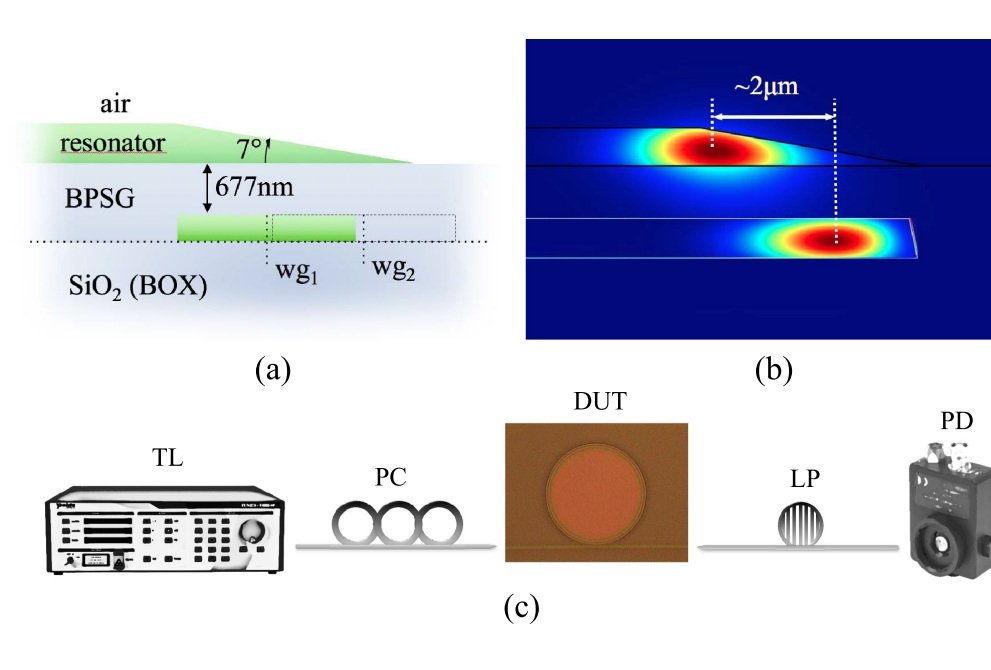
A multilayer silicon process places SiON bus waveguides beneath planar silica wedge resonators. Reflow planarisation and independently defined vertical and horizontal offsets provide access to retracted wedge modes that cannot be efficiently reached by conventional side coupling.
Simulations & fits
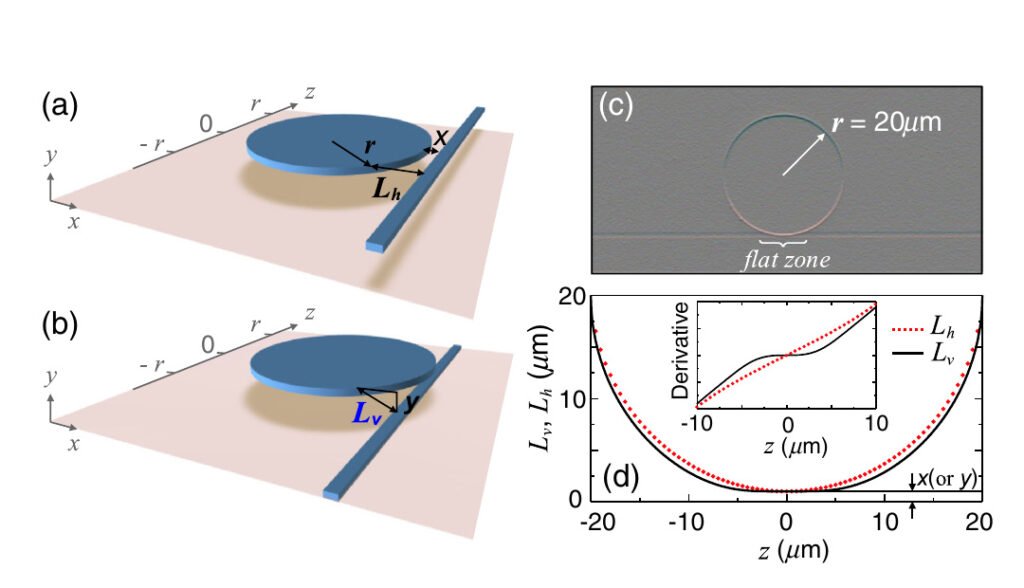
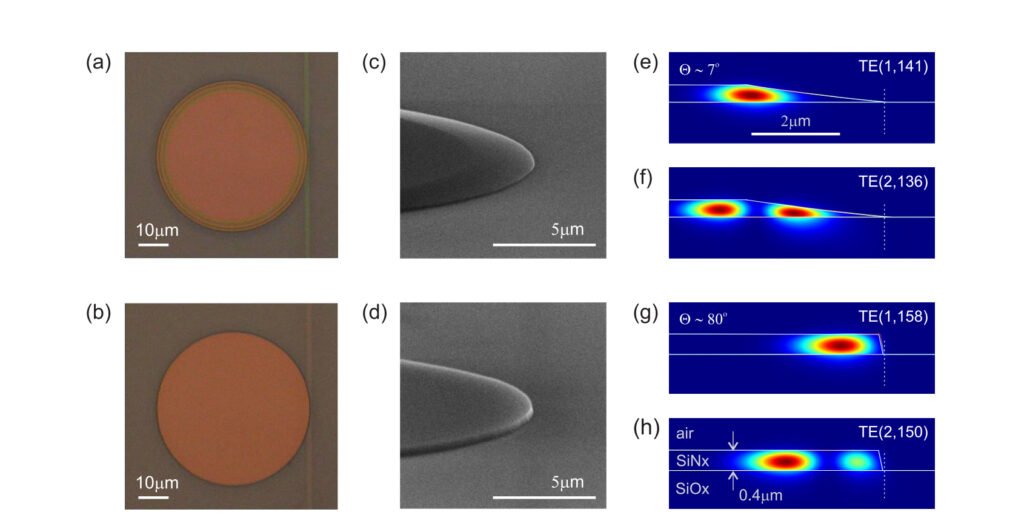
Mode profiles and coupling-overlap calculations guide the resonator-waveguide alignment and show how different radial families can be selected. Resonance fits then quantify loaded and intrinsic quality factors after integration.
Characterization
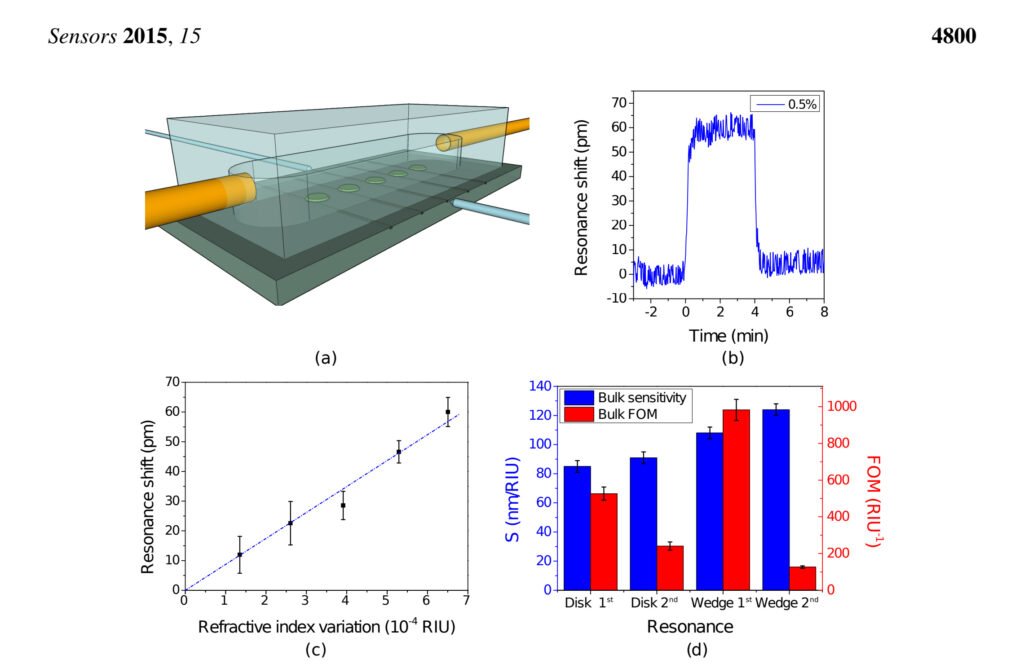
SEM and optical microscopy verify the process sequence and coupling geometry, while waveguide transmission spectra measure the completed devices. The results demonstrate high-Q cavity access in a monolithic layout intended for repeatable wafer-scale fabrication.
RESEARCH TOPICS
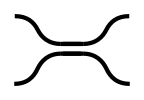 CouplingWedge resonators push their lowest-loss mode away from the sloped outer rim, which makes ordinary coplanar side coupling ineffective. Placing the bus in a separate vertical plane decouples the horizontal alignment from the vertical gap, allowing the retracted field to be reached without sacrificing the smooth wedge boundary.
 MaterialsThe monolithic stack combines PECVD silicon-nitride or silicon-oxynitride resonators with a buried SiON guide and silica-based cladding. Because guide and resonator are fabricated in separate vertical levels, their composition and thickness can be chosen independently within a CMOS-compatible process.
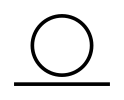 ResonatorsThe wedge geometry reduces scattering by smoothing the perimeter and retracting the fundamental whispering-gallery field from etched sidewall defects, supporting the high-Q goal. Measured transmission from inward-shifted buried guides exhibits clear cavity resonances, demonstrating that an ultra-high-Q-compatible geometry can be accessed on chip without an external tapered fibre.