Research · Publication & note
A fully integrated high-Q Whispering-Gallery Wedge Resonator - Notes

Article access and reuse
© 2012 Optical Society of America. The article was published in Optics Express. The figures shown on this author’s personal website are accompanied by the complete bibliographic attribution; reuse remains governed by the article’s access terms and Optica Publishing Group copyright policy.
Related publications



Research fields
Top-down
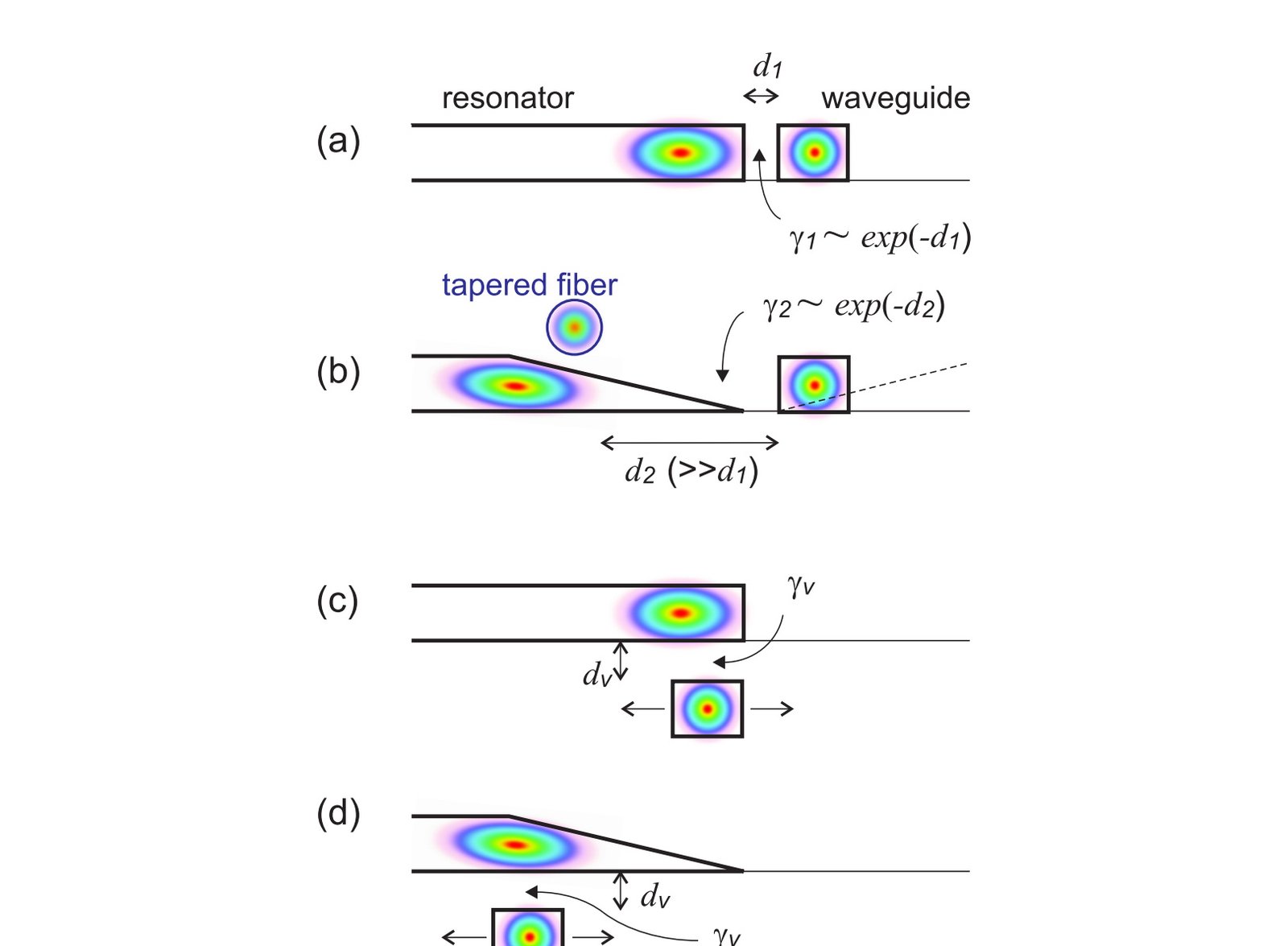
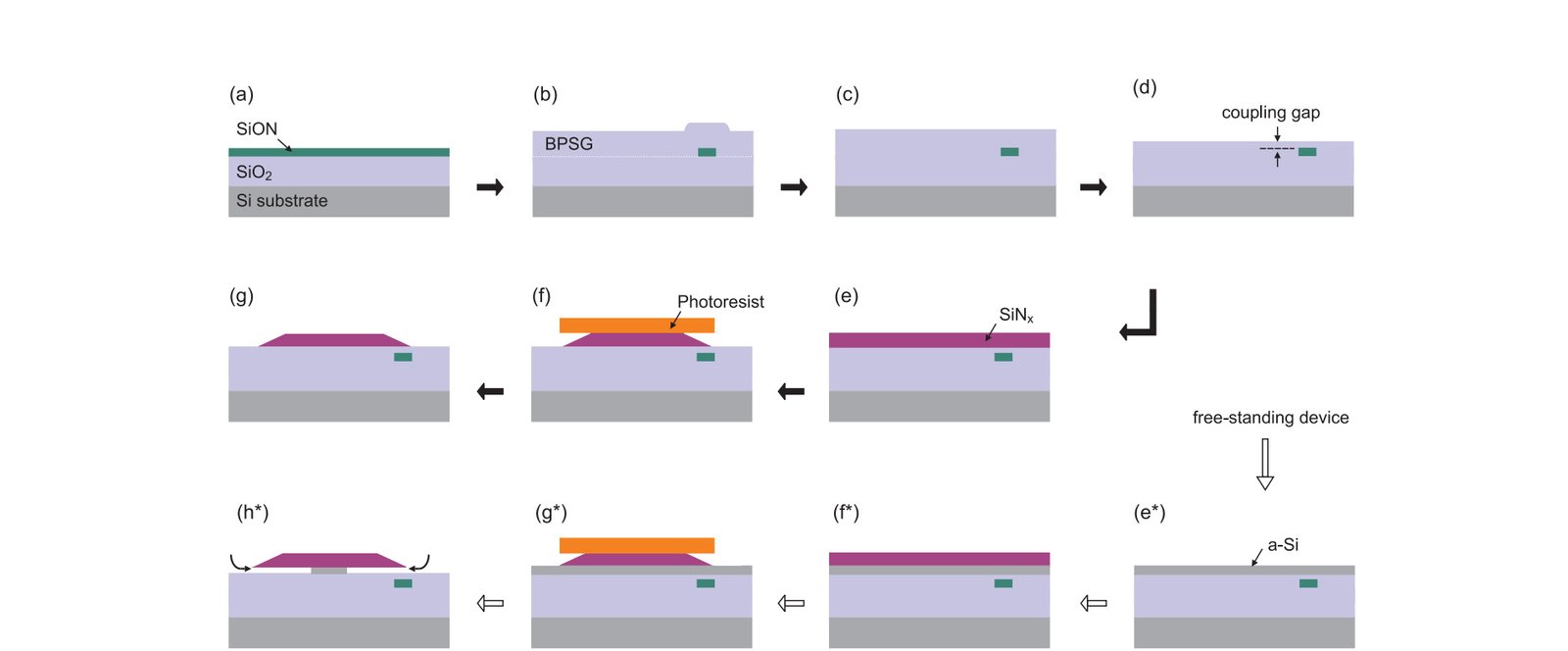
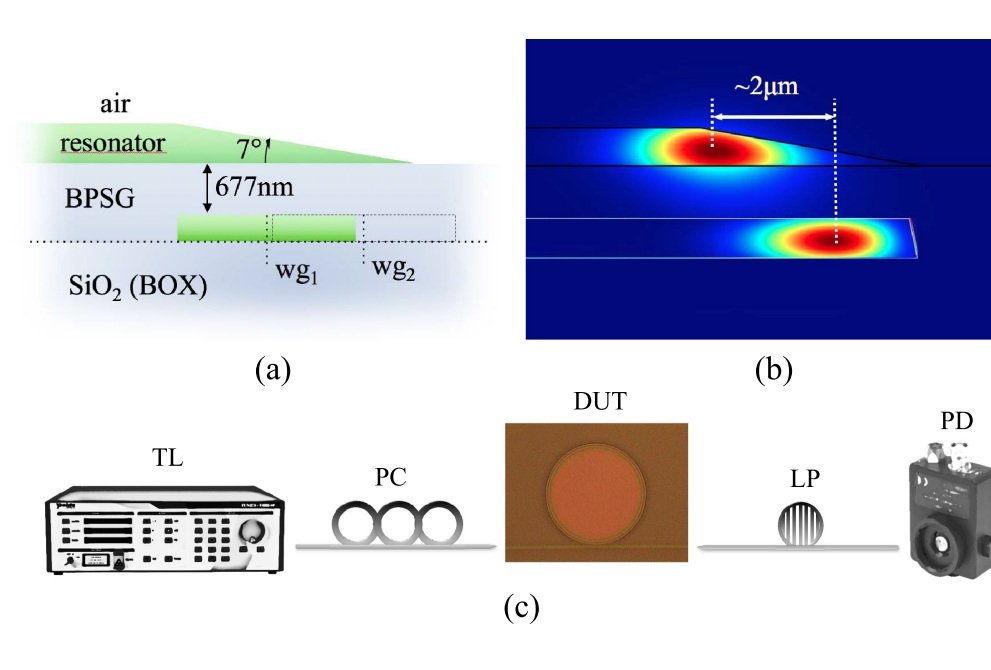
Conventional silicon microfabrication is used to build a silica wedge resonator directly above a buried SiON bus waveguide. Vertical coupling reaches the mode retracted from the wedge edge while preserving a planar, fully integrated chip.
Simulations & fits
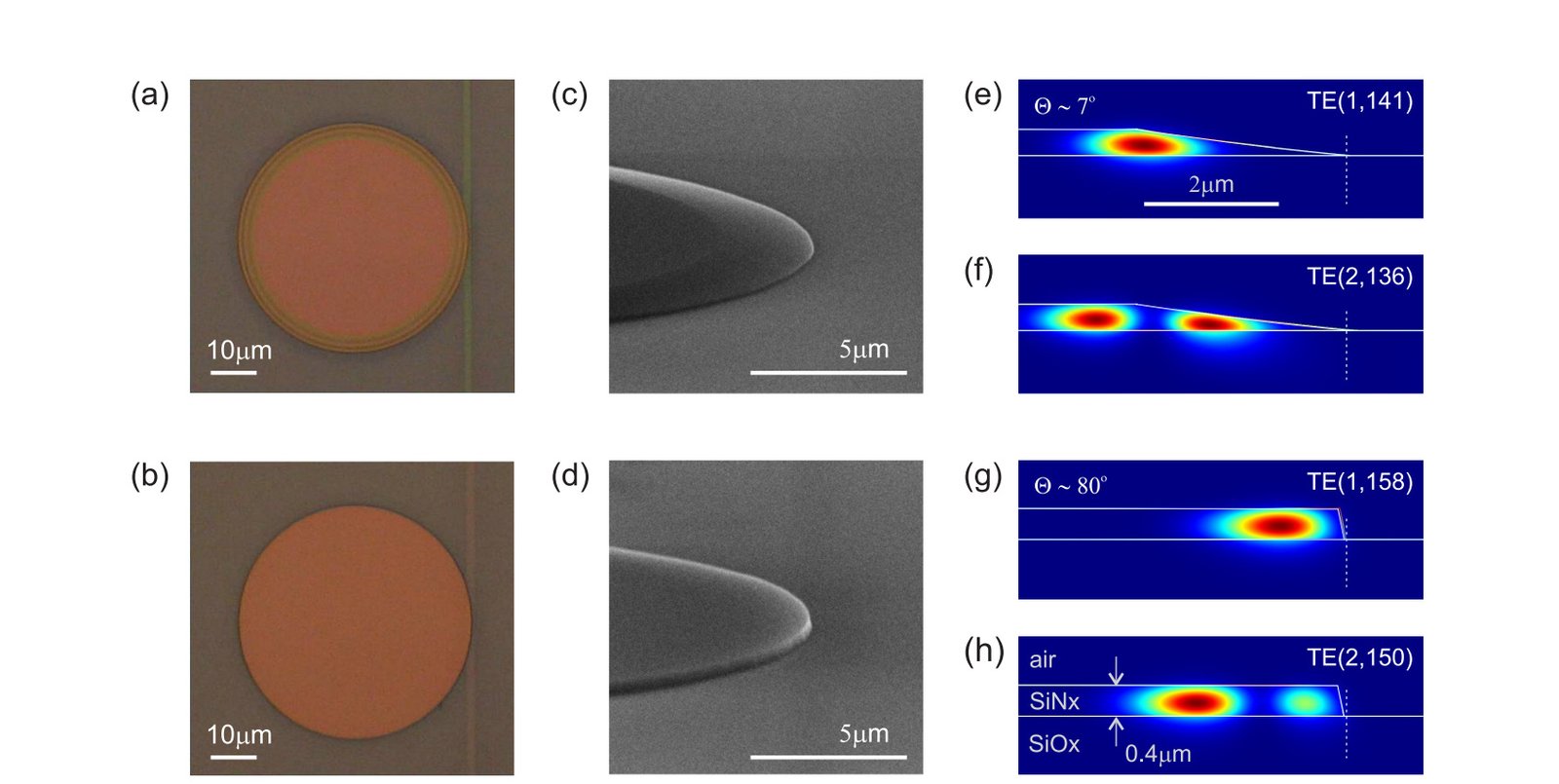
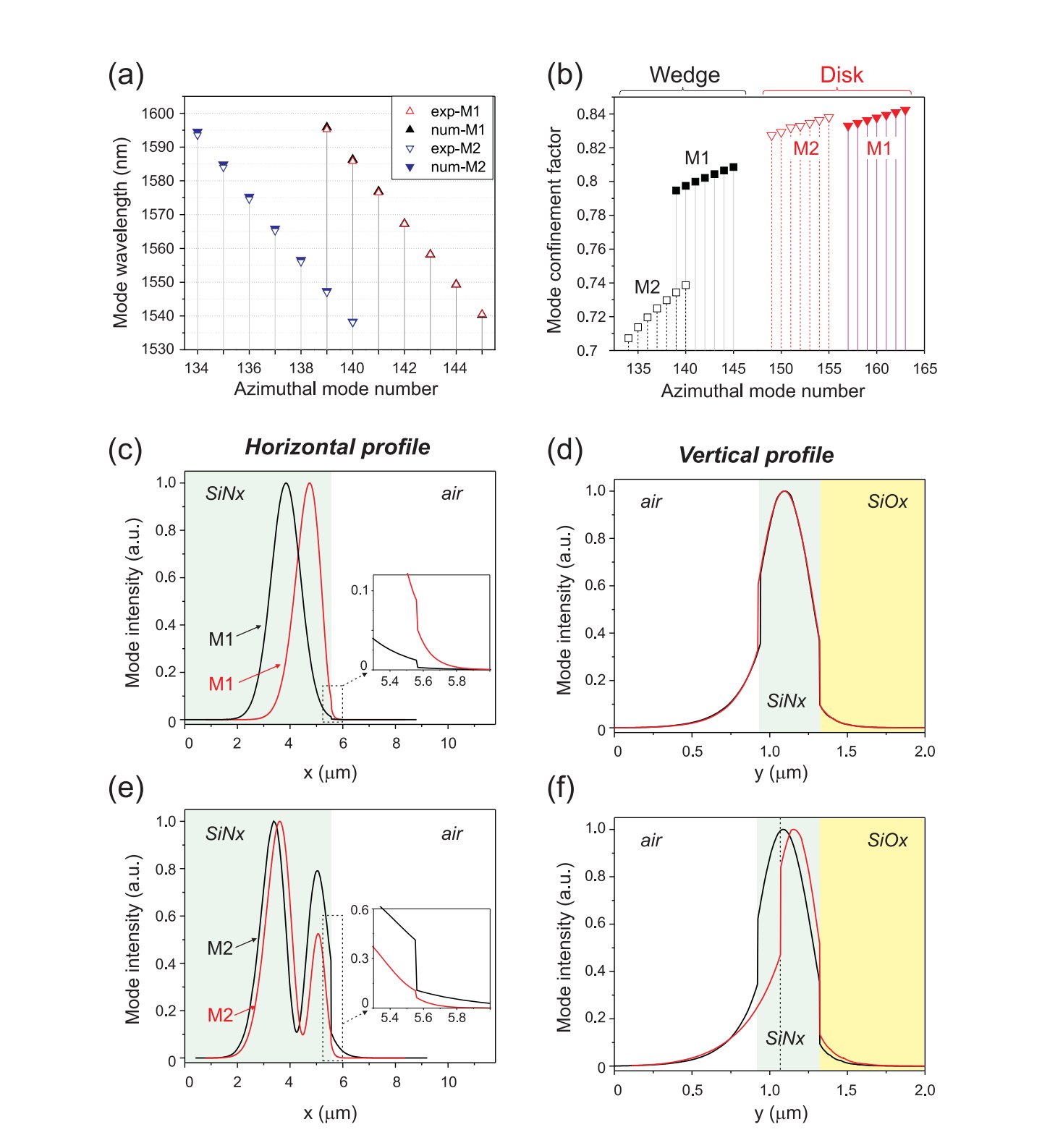
Calculated radial-mode profiles guide lateral waveguide placement and explain the different surface overlap of first- and second-order families. Resonance fits separate intrinsic and coupling losses and show where the integrated wedge retains its high quality factor.
Characterization
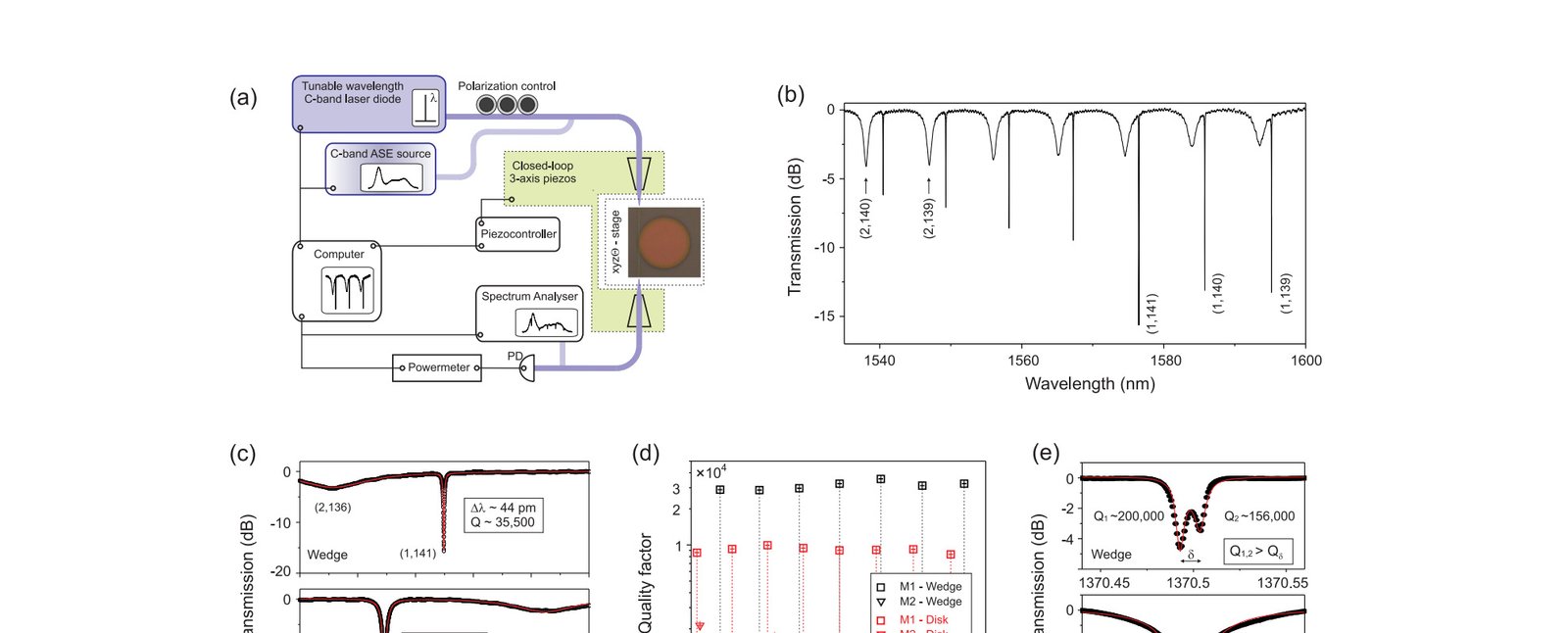
Optical images, cross-sectional inspection and broadband transmission spectra compare wedge and conventional disk devices. Measured quality factors and mode-family behaviour verify that integration has not simply traded accessible coupling for excessive cavity loss.
RESEARCH TOPICS
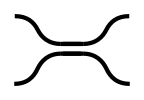 CouplingMeasured spectra show integrated access to both radial families without restoring the rough vertical sidewall that the wedge was designed to avoid. The coupling scheme therefore preserves the optical benefit of mode retraction rather than trading it for convenient excitation.
 MaterialsThe integrated device combines a 400 nm silicon-nitride resonator with a 300 nm silicon-oxynitride strip guide on a silica-based stack, all fabricated with standard lithography, PECVD and etching. Because material thickness, refractive index and process flow are held close between the two, their measured Q difference can be assigned to the boundary geometry and associated scattering rather than to unrelated material changes.
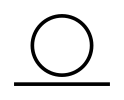 ResonatorsThe improvement is therefore not produced by abandoning confinement but by moving the field away from the etched rim and reducing surface-induced loss. The absence or presence of mode doublets provides an additional signature of boundary scattering.