Research · Publication & note
Thermo-Optical Bistability with Si Nanocrystals in a Whispering-Gallery-Mode Resonator - Notes
Optics Letters · Journal article · 6 September 2013
Published abstract
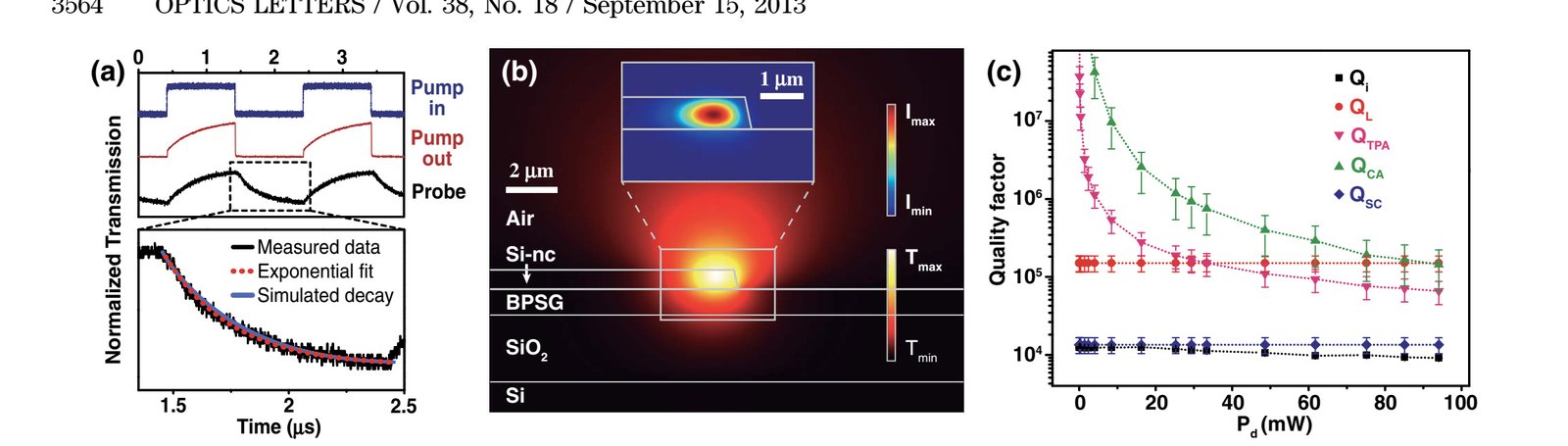
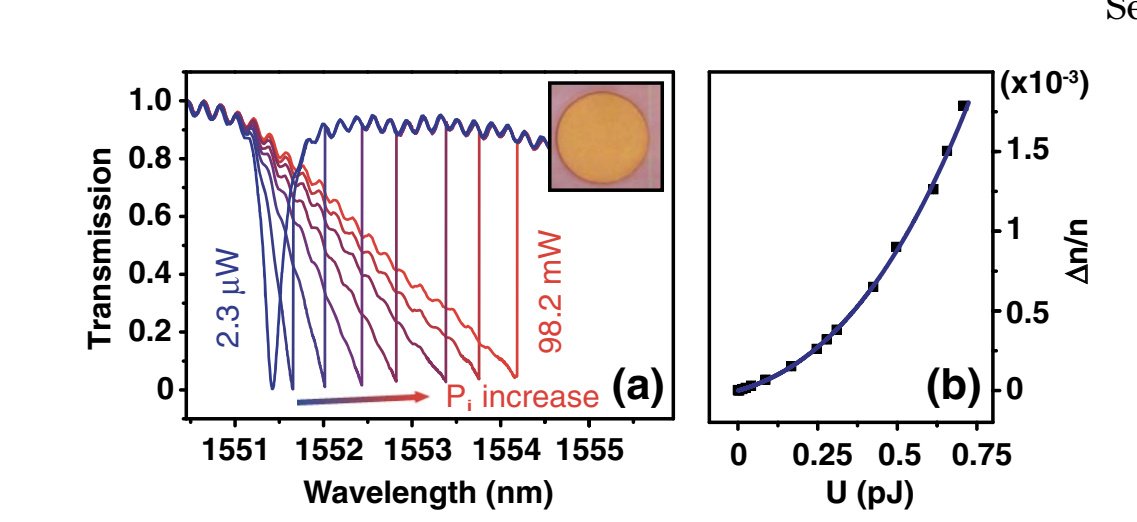
We report on the observation of optical bistability in an integrated planar microresonator with embedded silicon nanocrystals (Si-ncs). The phenomenon originates from the thermo-optical modulation of the silica-embedded Si-ncs refractive index, which in turn alters the spectral position of the resonator mode. The estimated thermo-optical coefficient of the Si nanocrystalline material, dn/dT ≈ 2.92 × 10⁻⁵ K⁻¹, is an order of magnitude lower than that of bulk silicon. Both time-resolved pump-and-probe experiments and numerical simulations confirm that the silica host is responsible for the heat dissipation from the resonator. Moreover, a negligible Q-factor degradation at pump powers as high as 100 mW, along with the absence of a fast component in time-resolved measurements, confirm the minute contribution from excited carriers effects. These observations, combined with the already published large third-order nonlinearities of Si-ncs (an order of magnitude larger than in bulk Si), make this system an outstanding candidate for low-power on-chip nonlinear comb generation.
Figures
From F. Ramiro-Manzano et al., Optics Letters 38(18), 3562-3565 (2013), DOI 10.1364/OL.38.003562. © 2013 Optical Society of America.
From F. Ramiro-Manzano et al., Optics Letters 38(18), 3562-3565 (2013), DOI 10.1364/OL.38.003562. © 2013 Optical Society of America.
How to cite
Article access and reuse
This article was published under Optical Society of America copyright. The local source reviewed for this catalogue is the published journal PDF, so the PDF itself is not hosted here. The selected original figures are shown with the complete article citation and copyright notice; reuse beyond the author's permitted scholarly use remains subject to the publisher's terms.
Related publications



Research fields
Top-down
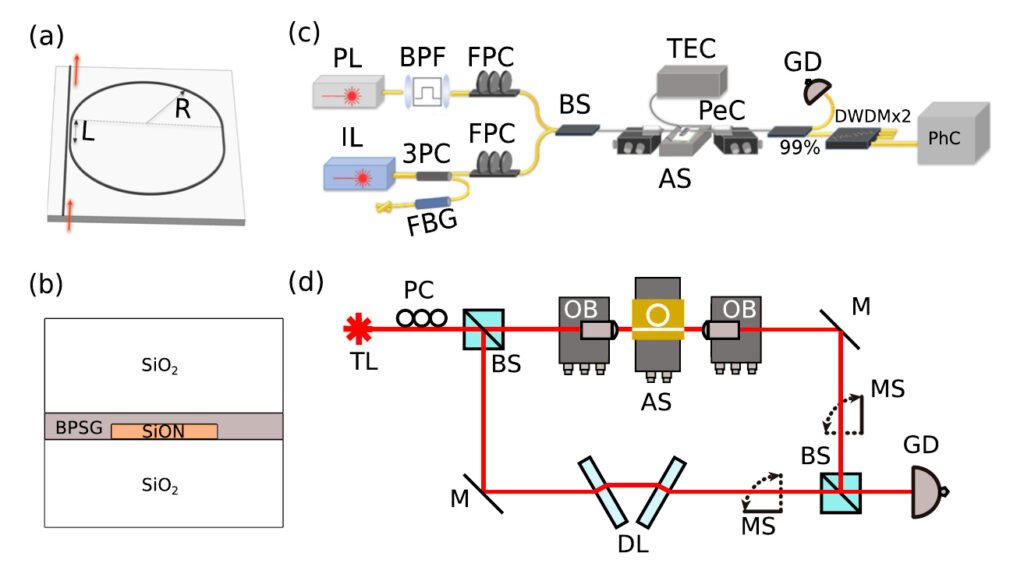
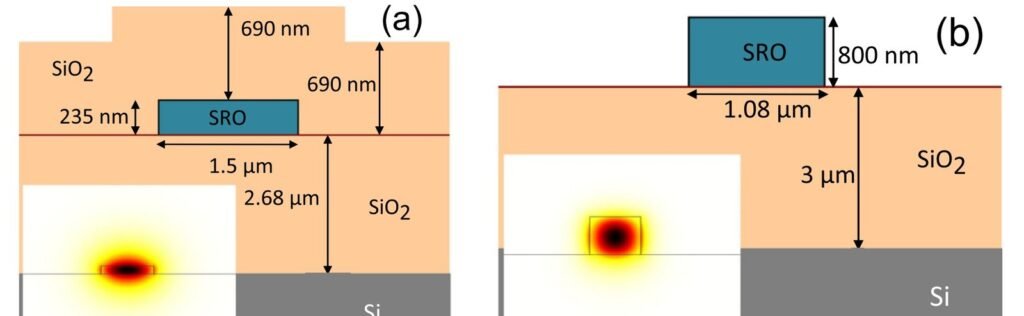
A silicon-nanocrystal microresonator is vertically coupled to an integrated bus waveguide so the active cavity material can be addressed without a fragile external taper. The geometry confines absorption-induced heating predominantly to the resonator.
Simulations & fits
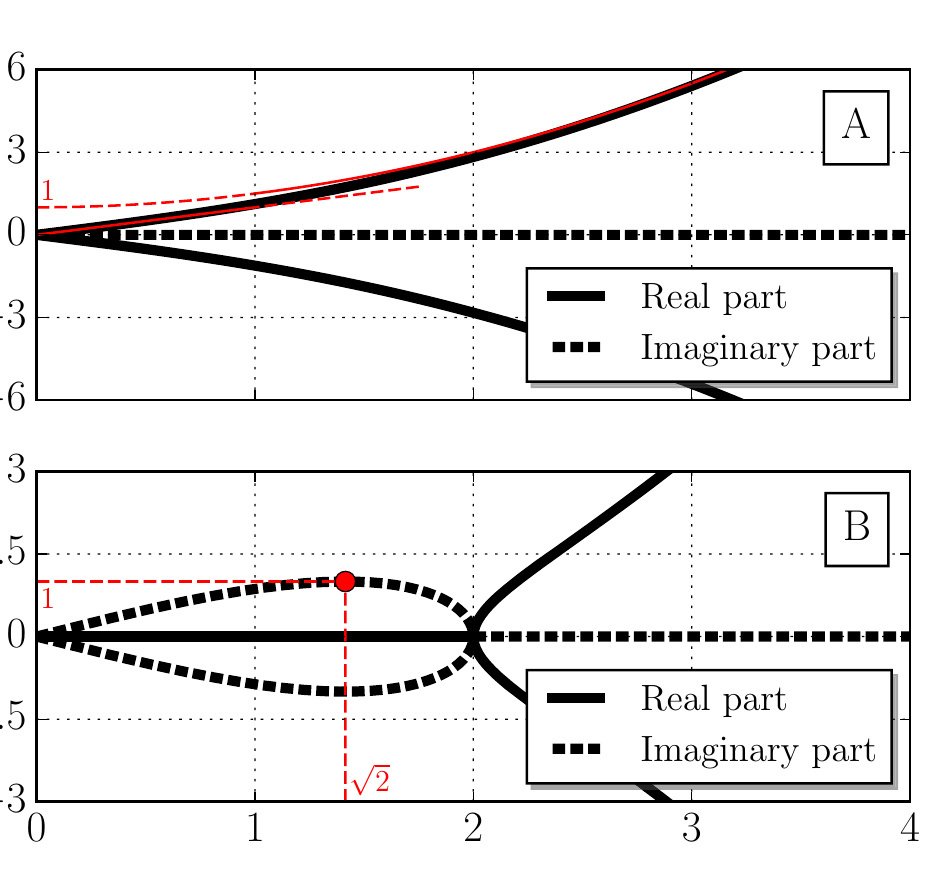
A thermo-optical cavity model relates absorbed power to resonance detuning and bistable transmission. Finite-element heat diffusion calculations reproduce the measured decay and map the temperature profile responsible for the two stable optical states.
Characterization
Power-dependent resonance scans reveal hysteresis, while a weak probe follows a second cavity mode during pump modulation. The combined steady-state and time-resolved measurements separate the thermo-optic response of the nanocrystals from an instantaneous Kerr interpretation.
RESEARCH TOPICS
 NonlinearThe bistable loop is resolved between separate up- and down-scan pump thresholds, so the same input conditions can support two stable transmission states. This decomposition matters for switching, because the mechanism that creates a large static hysteresis also determines how quickly the device can respond.
 ResonatorsA vertically coupled resonator concentrates the pump in the silicon-nanocrystal cavity while the buried bus provides controlled access without sharing the same material layer. Q remains essentially unchanged up to 100 mW input, showing that the observed bistability is not simply the resonance collapsing through increasing optical loss.
 EmissionTogether with the stable intrinsic Q, this observation constrains the role of carrier absorption and supports the thermo-optic interpretation of the hysteresis. The emission-related material is therefore examined dynamically, not included merely because silicon nanocrystals can luminesce.