Research · Publication & note
Stimulated Degenerate Four-Wave Mixing in Si Nanocrystal Waveguides - Notes
Journal of Optics · Journal article · 14 June 2016
Published abstract
Parametric frequency conversion via four-wave mixing (FWM) in silicon nanocrystal (Si NC) waveguides is observed at 1550 nm. To investigate the role of Si NC, different types of waveguides containing Si NC in a SiO₂ matrix were fabricated. Owing to the increase of the dipole oscillator strength mediated by the quantum confinement effect, the non-linear refractive index (n₂) of Si NCs is found to be more than one order of magnitude larger than the one of bulk Si. Coupled differential equations for the degenerate FWM process taking into account the role of Si NC were numerically solved to model the experimental data. The modeling yields an effective n₂ for Si NCs in SiO₂ waveguides which is similar to the one of Si waveguides. We also measured a large signal to idler conversion bandwidth of ∼22 nm. The large non-linear refractive index is joined with a large two photon absorption coefficient which makes the use of Si NC in non-linear optical devices mostly suitable for mid-infrared applications.
Figures
From S. Manna et al., Journal of Optics 18(7), 075801 (2016), DOI 10.1088/2040-8978/18/7/075801. © 2016 IOP Publishing Ltd.
From S. Manna et al., Journal of Optics 18(7), 075801 (2016), DOI 10.1088/2040-8978/18/7/075801. © 2016 IOP Publishing Ltd.
How to cite
Article access and reuse
This article was published on a subscription basis by IOP Publishing. IOP permits authors to share the accepted manuscript under its author-rights policy and to reuse their original figures with appropriate acknowledgement. The local file reviewed here is the typeset Version of Record, so the PDF is not hosted. The two selected figures are reproduced with full citation and copyright notice.
Related publications



Research fields
Top-down
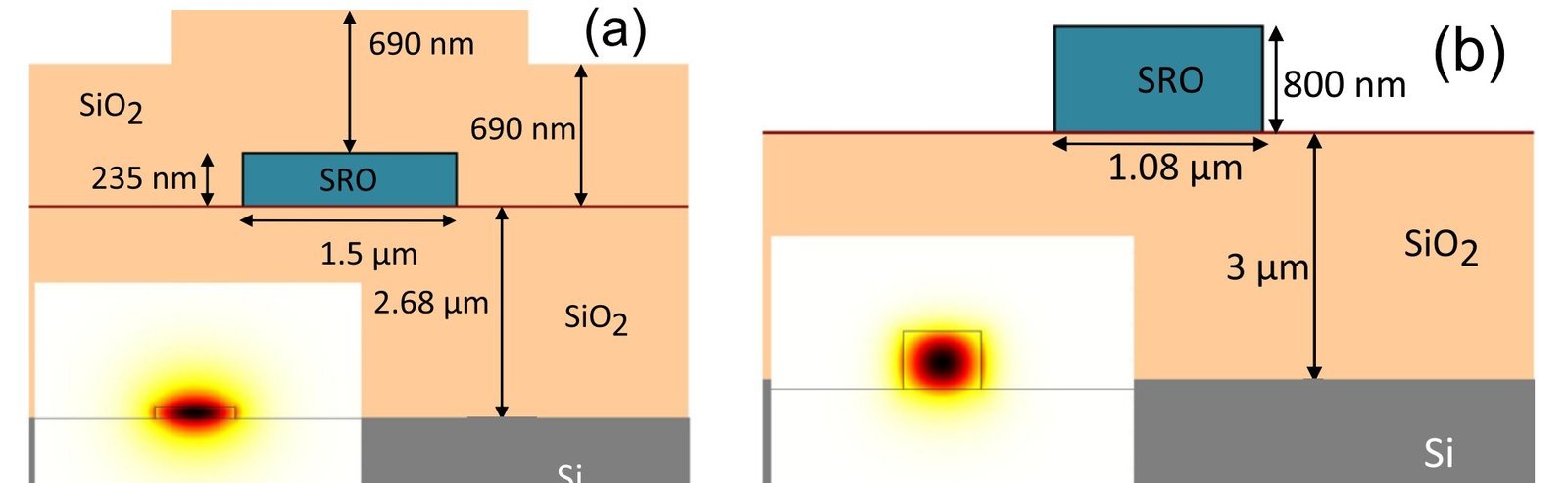
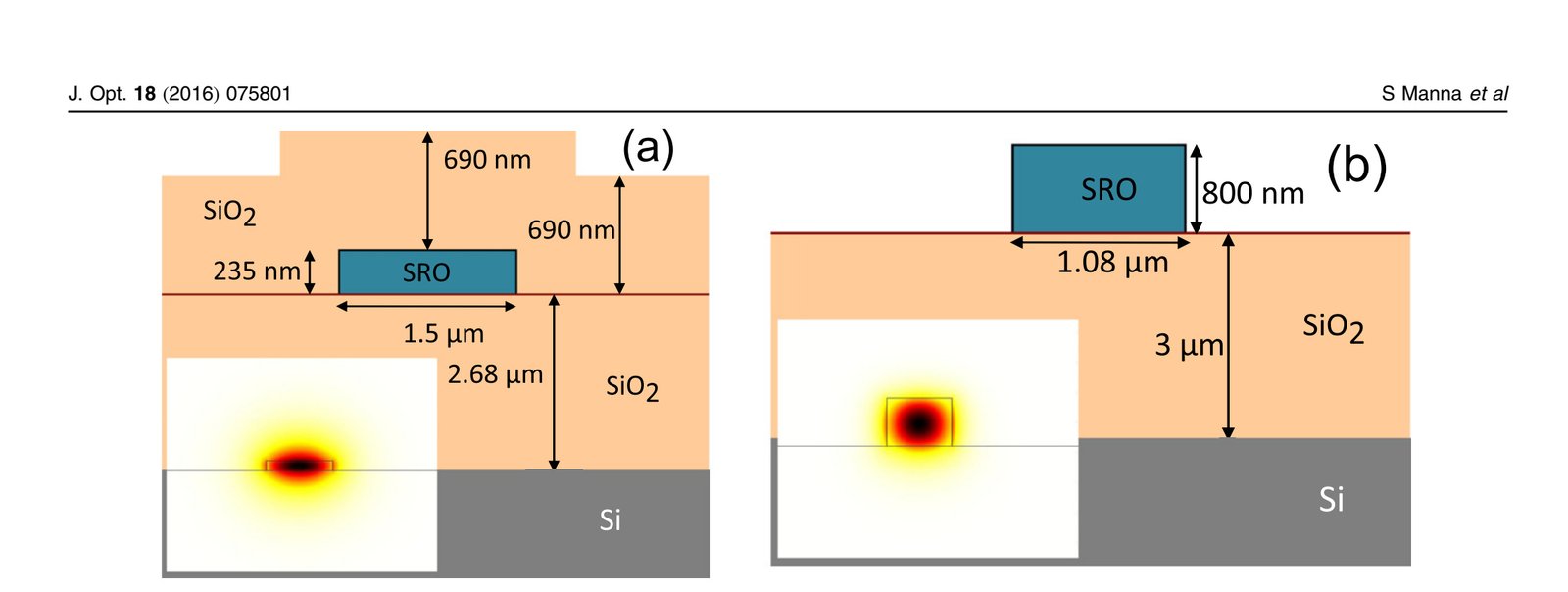
Silicon-nanocrystal-rich silica is patterned into channel and stripe waveguides with different core dimensions and nanocrystal concentrations. These integrated structures provide controlled interaction lengths for telecom-band four-wave mixing.
Simulations & fits
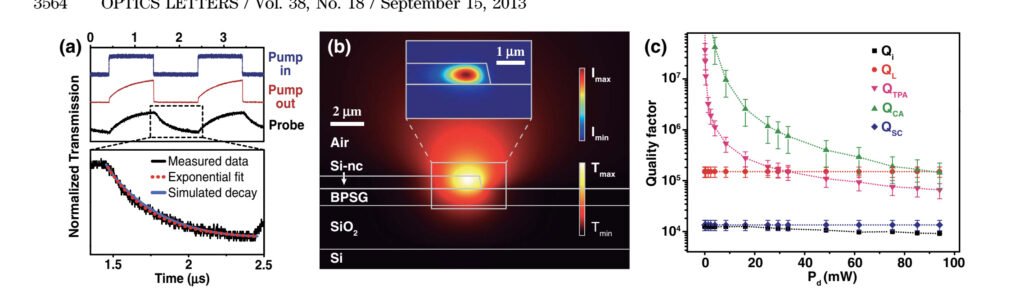
Coupled propagation equations include linear loss, two-photon absorption, free carriers and the nanocrystal contribution to the Kerr response. Numerical fitting of signal and idler conversion isolates an effective nonlinear index and explains the measured conversion bandwidth.
Characterization
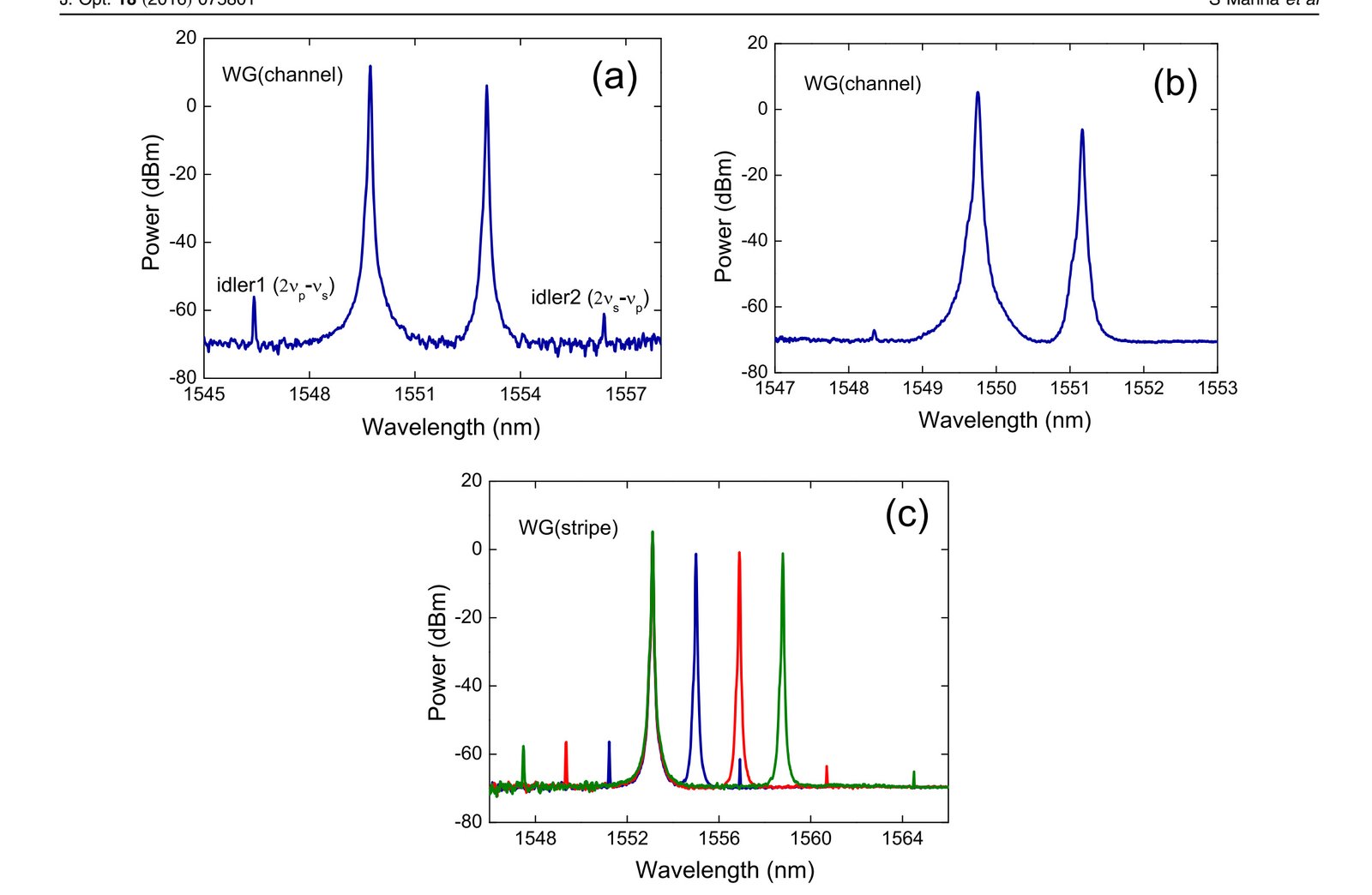
Degenerate pump-probe spectra around 1550 nm quantify generated idler power, propagation loss and two-photon absorption for the different waveguides. The comparison shows a strong nanocrystal-enhanced nonlinearity accompanied by absorption that favours operation farther into the mid-infrared.
RESEARCH TOPICS
 InterferenceThe stripe waveguide yields stronger conversion than the channel device because its propagation constants and modal overlaps reduce the mismatch. Comparing the two geometries makes the interference requirement experimentally visible: identical nonlinear material does not guarantee equal wavelength conversion if the generated field accumulates the wrong phase along the guide.
 MaterialsThe effective device nonlinearity is lower because only part of the mode overlaps the nanocrystals. The paper therefore reports both an intrinsic material advantage and the dilution imposed by the composite waveguide.
 MultimodeStripe and channel cross-sections support different transverse field distributions, changing how pump, signal and idler overlap with one another and with the nanocrystal-rich region. The comparison shows that nonlinear-waveguide design must optimise mode shape and propagation constant together; increasing confinement alone does not ensure more useful mixing.
 NonlinearThe conversion model includes stimulated four-wave mixing together with two-photon absorption, excited-carrier absorption and carrier lifetime. The conclusion is a wavelength-specific design strategy, not a generic claim of lossless conversion.