Research · Publication & note
Thermo-optic coefficient and nonlinear refractive index of silicon oxynitride waveguides - Notes
Research article
Published abstract
Integrated waveguiding devices based on silicon oxynitride (SiON) are appealing for their relatively high refractive index contrast and broadband transparency. The lack of two photon absorption at telecom wavelengths and the possibility to fabricate low loss waveguides make SiON an ideal platform for on-chip nonlinear optics and for the realization of reconfigurable integrated quantum lightwave circuits. Despite this, very few studies on its linear and nonlinear optical properties have been reported so far. In this work, we measured the thermo-optic coefficient dn/dT and the nonlinear refractive index n₂ of relatively high (n ∼ 1.83 at a wavelength of 1.55 μm) refractive index SiON by using racetrack resonators. These parameters have been determined to be dn/dT = (1.84 ± 0.17) × 10⁻⁵ K⁻¹ and n₂ = (7 ± 1) × 10⁻¹⁶ cm² W⁻¹.
Figures
Source: A. Trenti et al., AIP Advances 8, 025311 (2018), CC BY 4.0.
Source: A. Trenti et al., AIP Advances 8, 025311 (2018), CC BY 4.0.
Source: A. Trenti et al., AIP Advances 8, 025311 (2018), CC BY 4.0.
Article access and reuse
This open-access article is distributed under the Creative Commons Attribution 4.0 licence; the journal version is the authoritative record. Official AIP article record · CC BY 4.0 licence · AIP rights and permissions.
Related publications

Research fields
Top-down
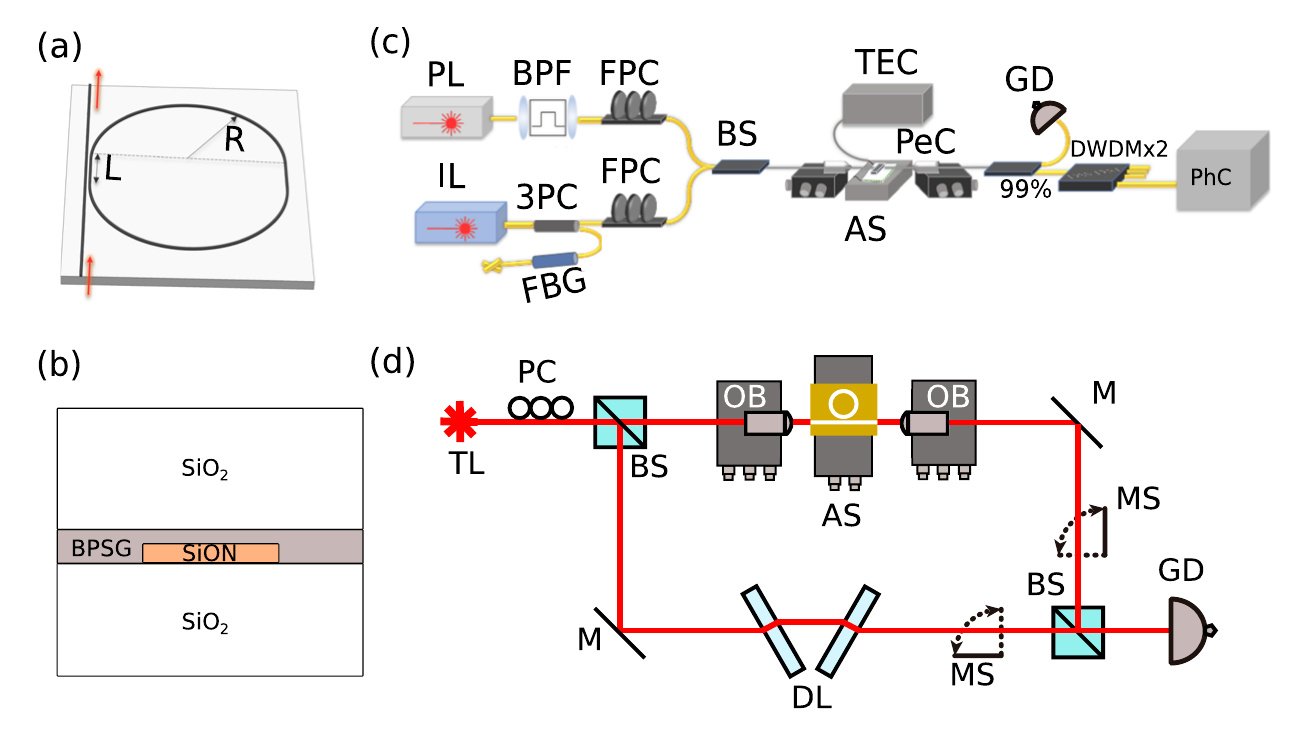
PECVD silicon oxynitride is patterned into channel waveguides and side-coupled racetrack resonators on silicon, then clad and interfaced for fibre access. The resonator converts small refractive-index changes into accurately measurable spectral shifts.
Simulations & fits
Finite-element mode calculations provide the SiON confinement factor used to recover material coefficients from effective-index measurements. Power-dependent resonance models separate Kerr and thermal contributions and support extraction of the nonlinear refractive index.
Characterization
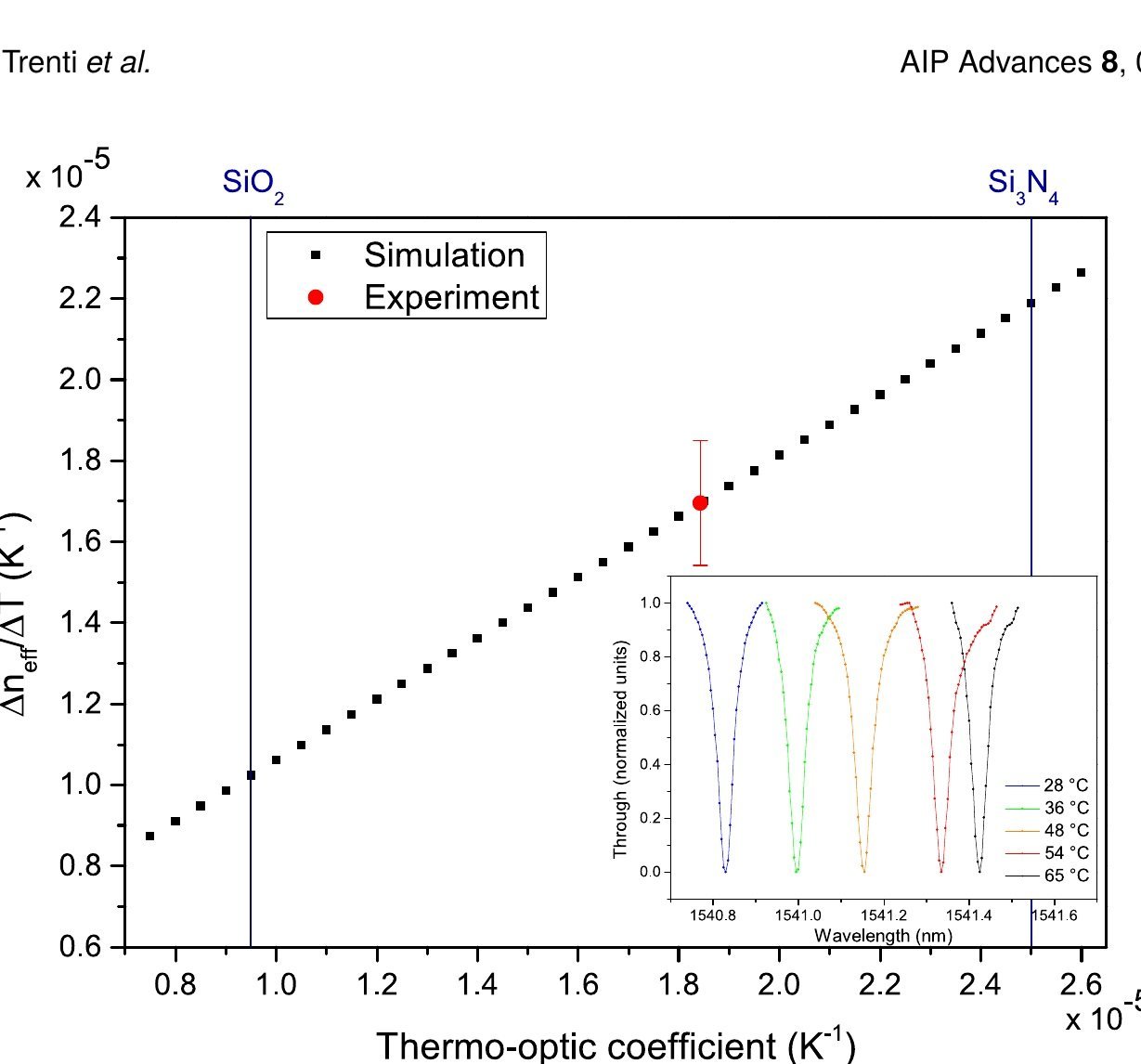
Temperature-controlled resonance tracking determines a thermo-optic coefficient of about 1.84 × 10⁻⁵ K⁻¹, while a pump-probe experiment measures an isotropic nonlinear index near 7 × 10⁻¹⁶ cm² W⁻¹. Both are obtained on the same integrated material platform.
RESEARCH TOPICS
 MaterialsThe waveguide core is silicon oxynitride with an effective refractive index near 1.83 at 1.55 μm. Separating this material coefficient from thermal expansion and stress is essential before using the same resonator to quantify optical nonlinearity.
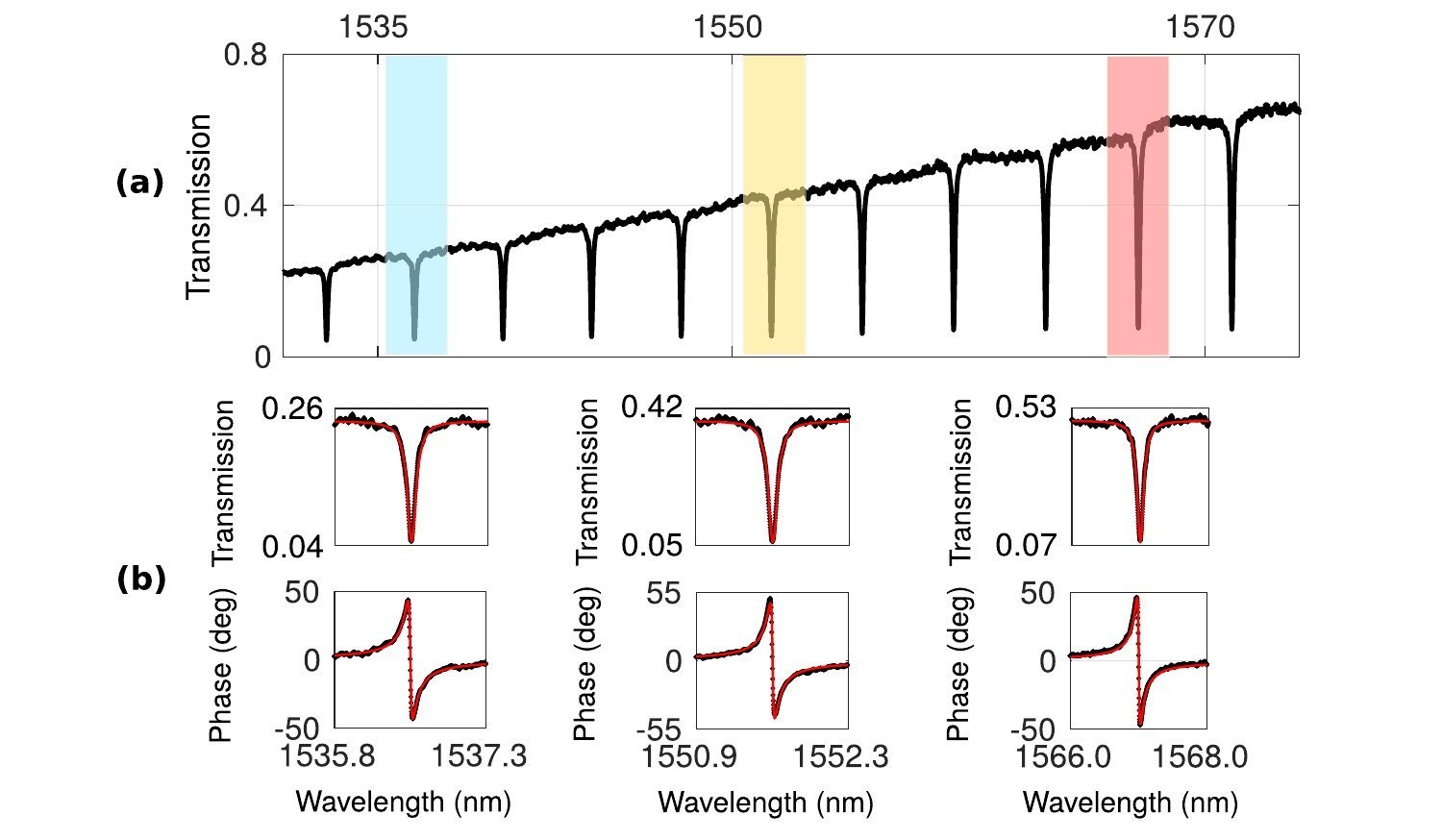
 NonlinearThe nonlinear refractive index is extracted through stimulated four-wave mixing rather than from a simple power-dependent resonance shift, which would mix Kerr, thermal and carrier effects. The resulting isotropic value, n2 = (7 ± 1) × 10⁻¹⁶ cm² W⁻¹, is about three times that of silica and establishes SiON as a useful moderate-index nonlinear platform.
 ResonatorsAn all-pass racetrack resonator turns small index changes into measurable spectral shifts and simultaneously enhances the pump, idler and generated FWM fields. The resonator is therefore both the sensor for thermo-optic response and the calibrated interaction volume for n2.
 SetupsTemperature measurements use a Peltier-controlled chip and follow resonance displacement while accounting for expansion and photoelasticity. A free-space phase-delay measurement determines the coupling regime, giving the experiment the independent quantities needed to avoid fitting the nonlinear coefficient from power alone.