Research · Publication & note
Hermitian and Non-Hermitian Mode Coupling in a Microdisk Resonator - Notes

Journal article
Published abstract
We make use of a phase-sensitive set-up to study the light transmission through a coupled waveguide-microdisk system. We observe a splitting of the transmission resonance leading to an unbalanced doublet of dips. The experimental data are analyzed by using a phasor diagram that correlates the real and the imaginary parts of the complex transmission. In addition, detailed features are evidenced by a complex inverse representation of the data that maps ideal resonances into straight lines and split resonances into complicated curves. Modeling with finite element method simulations suggests that the splitting and the unbalance is caused by an induced chirality in the propagation of the optical fields in the microdisk due to the interplay between the stochastic roughness and the intermodal dissipative coupling, which yield an asymmetric behavior. An analytical model based on the temporal coupled mode theory shows that both a reactive and a dissipative coupling of the counter-propagating modes by the surface roughness of the ring resonator are required to quantitatively reproduce the experimental observations and the numerical simulations.
How to cite
Article access and reuse
The publisher-formatted article identifies IEEE as the copyright holder and permits personal use and academic text and data mining; republication or redistribution requires IEEE permission. Therefore this page links to the official record and does not reproduce the publisher PDF or its figures independently.
Related publications
Research fields
Top-down
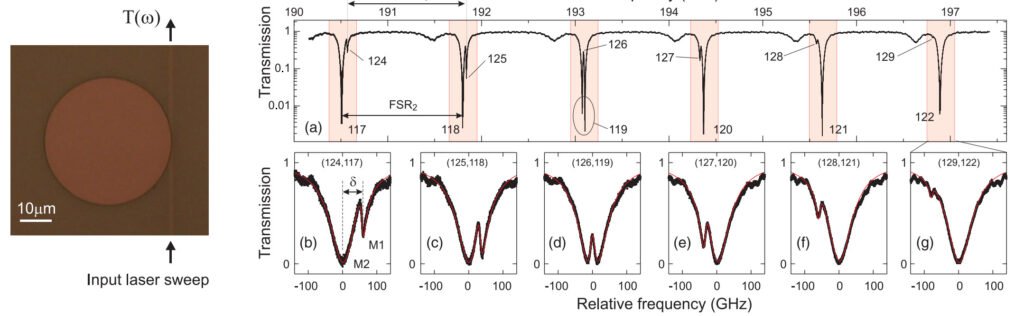
A lithographically defined bus waveguide is vertically coupled to a wedge microdisk resonator. The integrated geometry gives controlled access to several radial mode families whose interaction is altered by unavoidable sidewall and surface disorder.
Simulations & fits
Three-dimensional field calculations and disorder-dependent coupling models reproduce balanced, unbalanced and hidden resonance doublets. Complex-plane and inverse-transmission representations make the Hermitian frequency splitting and non-Hermitian linewidth coupling separately visible.
Characterization
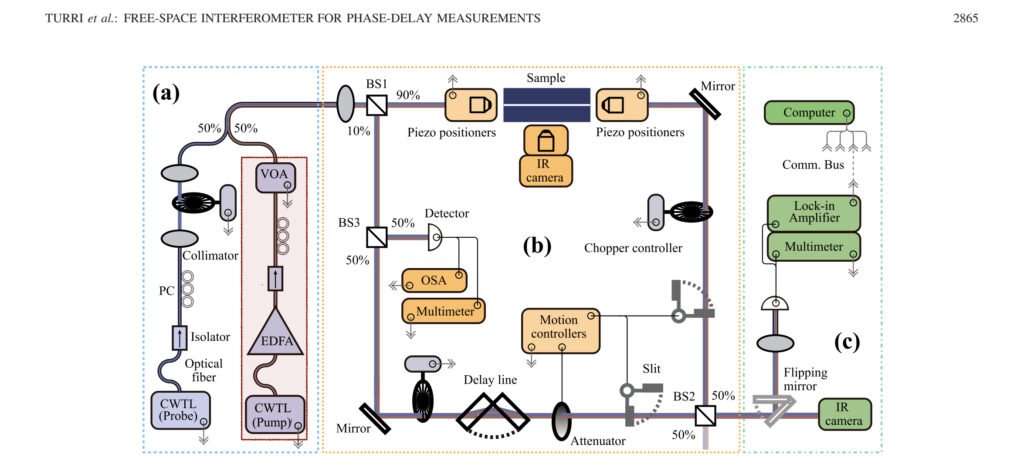
A phase-sensitive interferometric setup measures the complex waveguide transmission rather than intensity alone. Phasor trajectories reveal induced chirality and asymmetry that would be difficult to identify from the two transmission dips by themselves.
RESEARCH TOPICS
 CouplingThat control rules out the bus-disk junction as the main source. The remaining coupling between clockwise and counter-clockwise resonator modes is attributed to stochastic surface roughness and its coupling to external radiation channels.
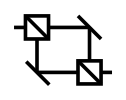 InterferenceIntensity alone can hide the mode interaction. A free-space Mach-Zehnder interferometer measures both transmitted power and phase while the laser is swept, revealing split resonances with unequal lobes and cases where phase splitting remains visible even when the transmission dip appears unsplit.
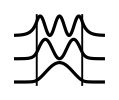 MultimodeThe disk supports clockwise and counter-clockwise waves and more than one radial family; Figures 2(b,c) show the first and second radial field profiles. Those reactive and dissipative contributions explain why splitting, linewidth and lobe amplitude vary between azimuthal resonances even within the same fabricated disk.
 ResonatorsWith Q around 105, small surface perturbations become spectrally resolvable and the wedge microdisk provides a sensitive test of non-Hermitian mode theory. The resonator is therefore used as an experimental platform for distinguishing internal mode coupling from loading and radiative loss.