Research · Publication & note
Silicon Nanocrystals for Nonlinear Optics and Secure Communications - Notes

Review article
Published abstract
Silicon nanocrystals (Si-nc) are reviewed here for their interesting optical applications. On the one hand, they do exhibit quantum confinement effects. This allows turning silicon into a light-emitting material where luminescence can be excited by electrical injection. On the other hand, small sizes, large surfaces, and dielectric mismatch between the core and the surrounding matrix increase dramatically the nonlinear optical coefficients. This allows using Si-nc as a nonlinear material in different waveguide configurations. In this paper, we discuss specifically two different applications of Si-nc: (i) as a nonlinear material in various devices, e.g., in bistable optical cavities, in waveguide optical mode monitors that are based on two-photon excited luminescence detection, and in wavelength shifters by using four-wave mixing (FWM); (ii) as an entropy source for quantum random number generation, the key device for cryptography.
Article access and reuse
The supplied Wiley published PDF is used locally for verification. No PDF or extracted figures are republished because no open reuse licence was identified. Consult the official Wiley record and permissions service. Official Wiley article record · Rights and permissions.
Related publications


Research fields
Bottom-up
Silicon nanocrystals are formed inside silicon-rich oxide by deposition followed by thermal annealing, with chemically synthesised nanocrystals discussed as a complementary route. Quantum confinement and interface passivation turn this material preparation into an adjustable optical response.
Top-down
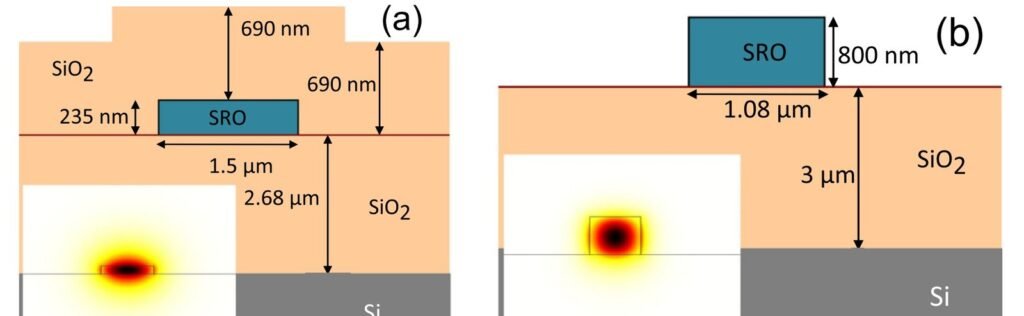
Nanocrystal-bearing films are incorporated into microdisks, resonators and slot or channel waveguides. Patterning defines the optical confinement needed to exploit emission, carrier absorption and Kerr effects within a silicon-compatible circuit.
Simulations & fits
Rate-equation, propagation and finite-element thermal models interpret pump-probe and switching experiments. They separate fast electronic nonlinearities from slower heating and quantify how nanocrystal concentration changes both useful index modulation and parasitic absorption.
RESEARCH TOPICS
 MaterialsThe review distinguishes two routes to silicon nanocrystals: annealing PECVD silicon-rich oxide and chemically transforming SiO1.5-type precursors such as hydrogen silsesquioxane. The surrounding oxide is not passive: it dilutes the effective optical response, confines carriers and determines how the nanocrystals can be incorporated into waveguides, microrings or light-emitting structures.
 NonlinearTwo-photon-excited photoluminescence maps the intensity of guided modes, while stimulated four-wave mixing tests useful wavelength conversion. That distinction explains why a material can provide strong steady-state switching yet have a different speed or loss penalty in telecom operation.
 QuantumFigure 19 converts photon statistics from a silicon-nanocrystal LED into random bits. The randomness is therefore tied to discrete spontaneous-emission events and verified statistics rather than to an arbitrary digitisation of analogue noise.