Research · Publication & note
Enhancement of TiO2 photocatalytic activity by structuring the photocatalyst film as photonic sponge - Notes
Journal article
Published abstract
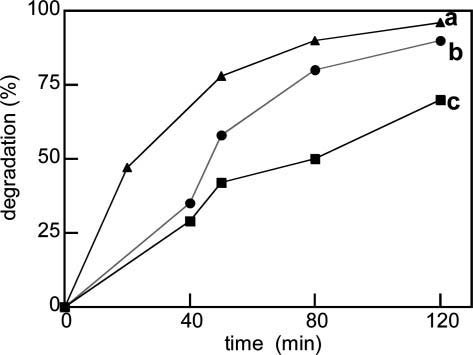
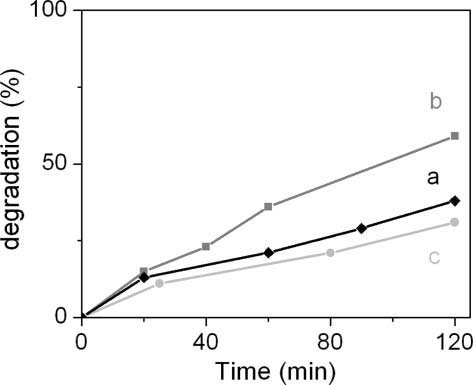
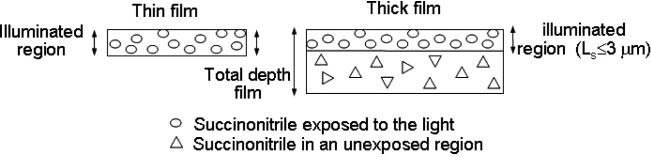
A TiO2 film having "photonic sponge" architecture (ps-TiO2) has been prepared using titania Degussa P25 nanoparticles that have been infiltrated into a template obtained through the arrangement of a mixture of different size latex spheres. The resulting photonic sponge exhibits 3.3 fold higher initial photocatalytic degradation rate for succinonitrile disappearance than analogous films of the same thickness made of unstructured P25 TiO2 nanoparticles. When corrected for the three fold lower mass of the ps-TiO2 films with respect to more dense P25, the enhancement of the photocatalytic activity by the photonic sponge morphology for the same mass of photocatalyst is about one order of magnitude. It was also observed that films of photonic sponge of 3 micrometres depth are more efficient than thicker films (5 and 7 micrometres).
Figures

From E. Carbonell et al., Photochem. Photobiol. Sci. 7, 931-935 (2008), DOI 10.1039/B801954A. Reproduced by the authors under RSC author reuse rights.
From E. Carbonell et al., Photochem. Photobiol. Sci. 7, 931-935 (2008), DOI 10.1039/B801954A. Reproduced by the authors under RSC author reuse rights.
From E. Carbonell et al., Photochem. Photobiol. Sci. 7, 931-935 (2008), DOI 10.1039/B801954A. Reproduced by the authors under RSC author reuse rights.
From E. Carbonell et al., Photochem. Photobiol. Sci. 7, 931-935 (2008), DOI 10.1039/B801954A. Reproduced by the authors under RSC author reuse rights.
From E. Carbonell et al., Photochem. Photobiol. Sci. 7, 931-935 (2008), DOI 10.1039/B801954A. Reproduced by the authors under RSC author reuse rights.
From E. Carbonell et al., Photochem. Photobiol. Sci. 7, 931-935 (2008), DOI 10.1039/B801954A. Reproduced by the authors under RSC author reuse rights.
From E. Carbonell et al., Photochem. Photobiol. Sci. 7, 931-935 (2008), DOI 10.1039/B801954A. Reproduced by the authors under RSC author reuse rights.
From E. Carbonell et al., Photochem. Photobiol. Sci. 7, 931-935 (2008), DOI 10.1039/B801954A. Reproduced by the authors under RSC author reuse rights.
How to cite
Article access and reuse
The published article is available from the Royal Society of Chemistry. RSC authors may reuse their own figures, diagrams, tables and images without a formal permission request when the material is fully acknowledged. The six figures and two schemes below were extracted as complete compositions from the local article PDF without enlargement.
Related publications
Research fields
Bottom-up
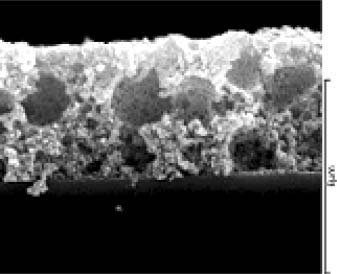
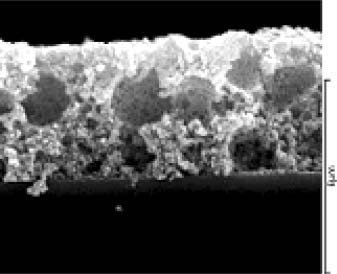
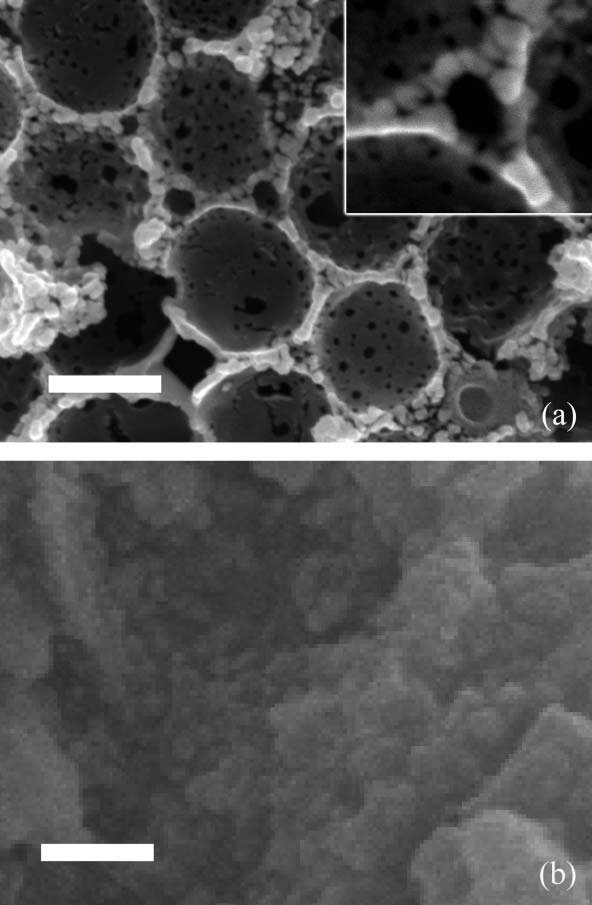
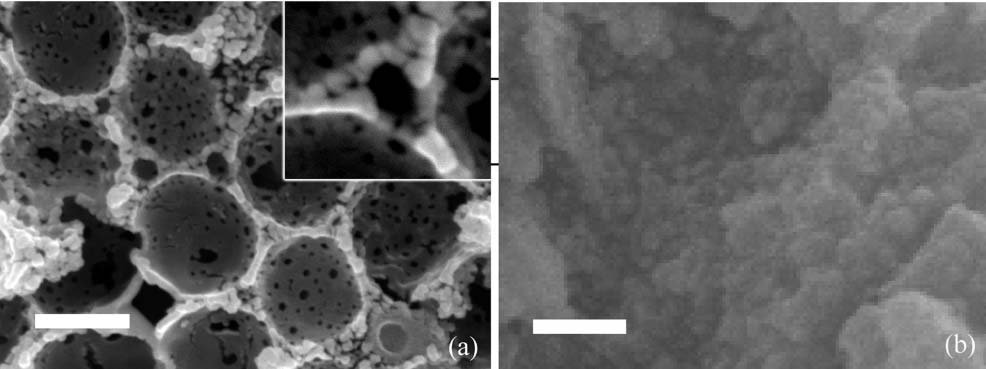
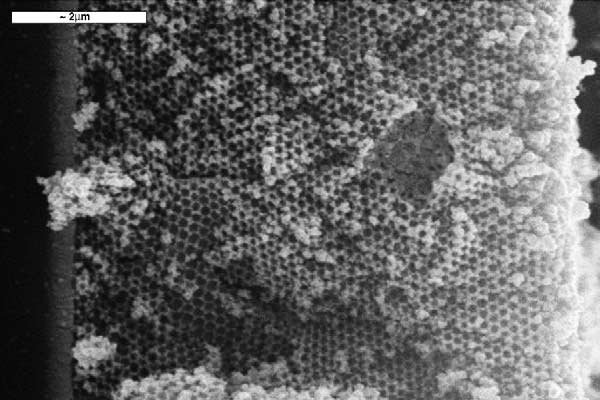
TiO₂ nanoparticles are assembled into a disordered hierarchical photonic sponge whose voids span the wavelength scale, while reference films use the same photocatalyst in a compact morphology. The comparison isolates structural light management from chemical composition.
Characterization
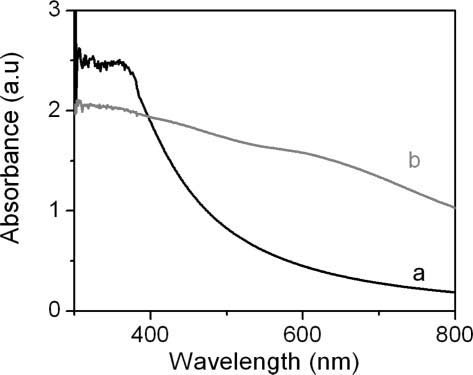
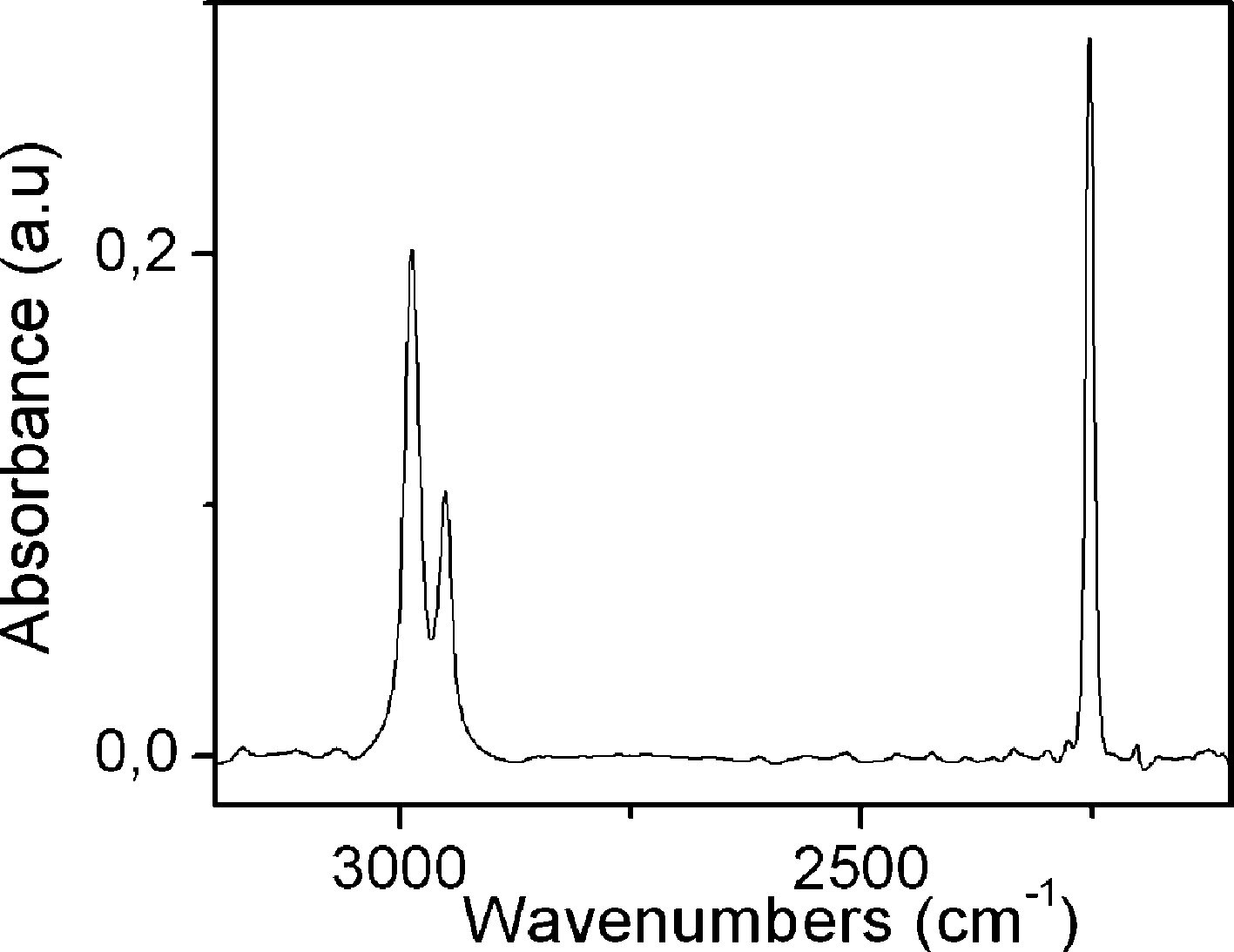
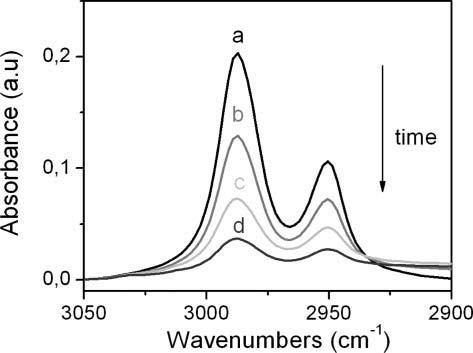
Cross-sectional SEM, optical absorbance and time-resolved infrared monitoring of succinonitrile degradation measure morphology, photon capture and catalytic outcome. Normalising for the lower TiO₂ mass shows that stronger activity follows enhanced absorption near the semiconductor edge.
RESEARCH TOPICS
 HarvestingThe porous architecture improves how incident photons are used rather than changing the TiO₂ chemistry. For films of equal thickness, the photonic sponge accelerates succinonitrile degradation by a factor of 3.3; after correcting for its three-times lower TiO₂ mass, the intrinsic activity enhancement is about one order of magnitude.
 InterferenceThe mixture of latex-sphere sizes creates a disordered network of voids from roughly 200 to 2000 nm, broadening the range of optical paths instead of producing one narrow photonic stop band. Figure 2 shows the strongest absorbance gain near the TiO₂ absorption edge above 380 nm, where multiple scattering keeps weakly absorbed photons inside the catalyst for longer.
 MaterialsDegussa P25 nanoparticles - approximately 80% anatase and 20% rutile - are packed around a sacrificial blend of latex spheres. Because the comparison samples use the same P25 material and processing, the measured activity difference can be assigned to morphology and photon transport rather than to a different semiconductor composition.
 ChemistryPhotocatalysis is followed through the disappearance of succinonitrile deposited on the films and irradiated with a medium-pressure mercury lamp above 300 nm. The porous sponge increases the reaction rate without metal or non-metal doping: the chemical gain comes from stronger absorption on the red side of the TiO₂ onset and from making more of the nanoparticle surface optically active.