Research · Publication & note
Advanced Optical Materials article accepted
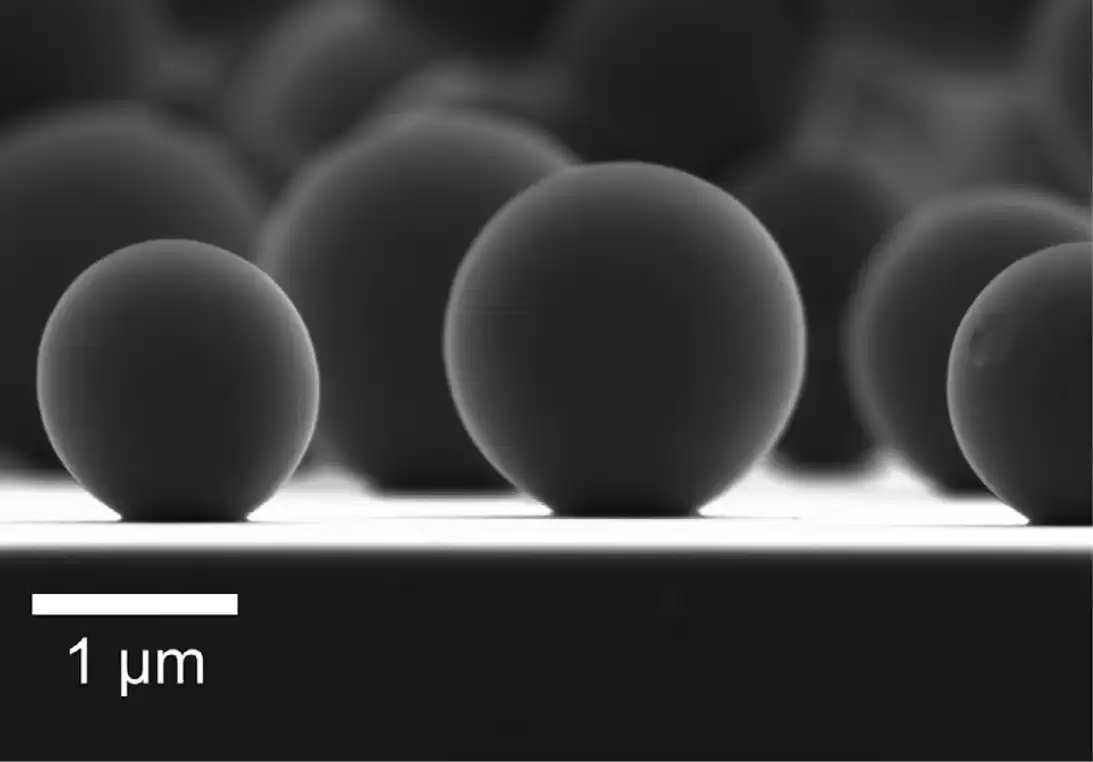
A research article on silicon microspheres as compact resonant thermal emitters has been accepted for publication in Advanced Optical Materials. The work explores how micrometre-scale silicon spheres can behave as photonic nanocavities and produce spectrally selective thermal emission through their optical resonances.
Conventional thermal sources are generally described by Planck’s law and emit over a broad spectral range. Micro- and nanostructured resonators offer a different route: their geometry and refractive index can redistribute the available optical states and concentrate emission into well-defined spectral bands. Silicon is particularly attractive for this purpose because it combines a high refractive index, mature fabrication knowledge and strong Mie resonances in the infrared.
In the reported experiments, silicon microspheres with diameters of approximately two to three micrometres were heated to temperatures between 500 and 600 °C. Under these conditions, the particles emitted light through narrow resonant modes whose spectral positions were governed by the size of the spheres. The measured emission peaks were significantly more intense than the black-body emission expected from an equivalent geometrical area at the same temperature.
This behaviour is usually described as super-Planckian emission at the scale of the individual resonator. It does not violate thermodynamics: the comparison depends on the effective optical absorption and emission cross-section, which can exceed the physical cross-section of a resonant particle at selected wavelengths. The result illustrates how optical resonances can be used to tailor thermal radiation in compact structures.
The study brings together material preparation, electron microscopy, optical spectroscopy and electromagnetic modelling. The agreement between experiment and calculations confirms that the observed spectral peaks originate from electric and magnetic Mie modes supported by the silicon microspheres.
Beyond the fundamental interest, resonant thermal emitters may contribute to compact infrared sources, sensing, spectroscopy and thermal-photonic devices. Their small dimensions and spectral selectivity make them promising building blocks for systems in which conventional broadband emitters are inefficient or difficult to integrate.
The article was authored by R. Fenollosa, F. Ramiro-Manzano, M. Garín and F. Meseguer. The complete bibliographic record, abstract, figures and publication links are available on the corresponding research page: Silicon Microspheres for Super-Planckian Light Sources in the Mid Infrared.