Research · Publication & note
The neuron as a temporal electroacoustic medium - Notes
Research publication
Published abstract
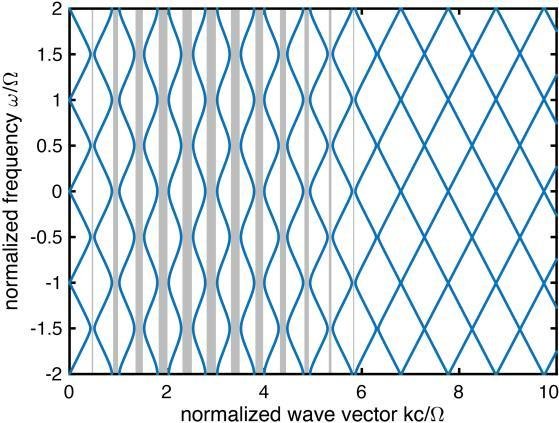
The human brain is one of the most complex and intriguing scientific topics. The most established theory on neuronal communication is a pure electrical model based on the propagation of intracell cationic charges along the neurons. Here we propose a complementary model based on two properties of brain communication: A) The Coulomb interaction associated to the Action Potential (AP) pulse induces a deformation of the neuron membrane which travels as an acoustic signal, i.e.: The ions play an essential role and the electric and acoustic signals, composing the AP, are strongly correlated. B) As brain communication is stablished through a periodic train of AP pulses it induces a time periodic modulation of the acoustic parameters. In this framework we propose envisaging the neuron as a temporal electro-acoustic medium. The temporal varying media framework could help understanding brain conundrums such as propagation routes involved in the neuronal plasticity in the consolidation of the memory, as well as on the generation of the signals associated to the brain field theory.
Figures
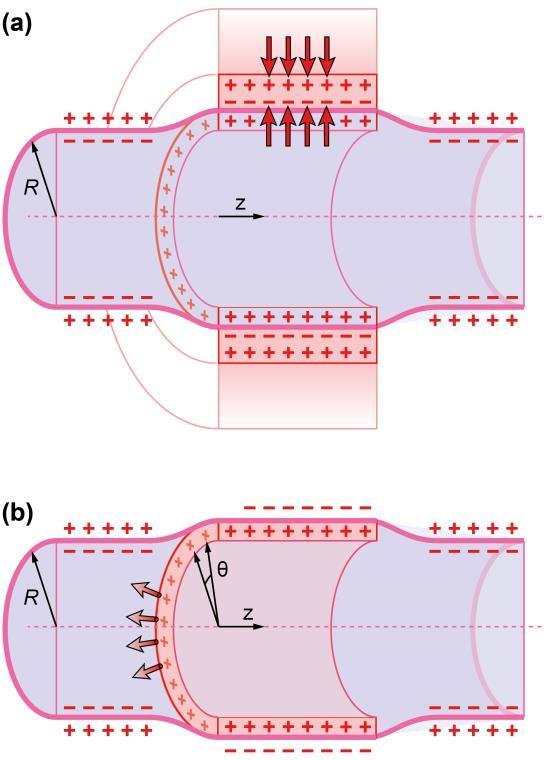
Source: F. Meseguer and F. Ramiro-Manzano, bioRxiv 2023.12.20.572553, CC BY-NC-ND 4.0.
Source: F. Meseguer and F. Ramiro-Manzano, bioRxiv 2023.12.20.572553, CC BY-NC-ND 4.0.
How to cite
Article access and reuse
The copyright holder for this preprint is the author/funder, which has granted bioRxiv a licence to display it in perpetuity. This version is available under CC BY-NC-ND 4.0. The figures are reproduced unchanged and with attribution. Official bioRxiv record and copyright notice.
Research fields
Simulations & fits
The paper develops an analytical electroacoustic description in which the ionic charge distribution of an action potential deforms the neuronal membrane and the pulse train periodically modulates its acoustic parameters. The resulting dispersion framework is used to examine how coupled electrical and mechanical signals could propagate in time-varying neuronal media.
RESEARCH TOPICS
 CouplingThe model couples the electrical and mechanical parts of an action potential through the Coulomb interaction of intra- and extracellular Na⁺ clouds. For myelinated axons, the authors further propose that this mechanical component can link neighbouring nodes of Ranvier through flexoelectric changes in membrane potential.
 InterferenceA periodic train of action potentials makes the acoustic parameters of the axon vary in time, so the neuron is treated as a temporal medium rather than a static transmission line. The paper presents these as theoretical possibilities to be tested, not as experimentally established brain modes.
 MultimodeThe model distinguishes propagation in unmyelinated and myelinated axons instead of assigning one universal pulse velocity. Using a 0.5 ms pulse width, the estimated acoustic wavelength is about 1 cm, much longer than the roughly 1 mm spacing between nodes of Ranvier.