Research · Publication & note
Catalyst-Free One-Step Synthesis of Large-Area Vertically Stacked N-Doped Graphene-Boron Nitride Heterostructures from Biomass Source - Notes
Nanoscale · Journal article · 1 March 2018
Published abstract
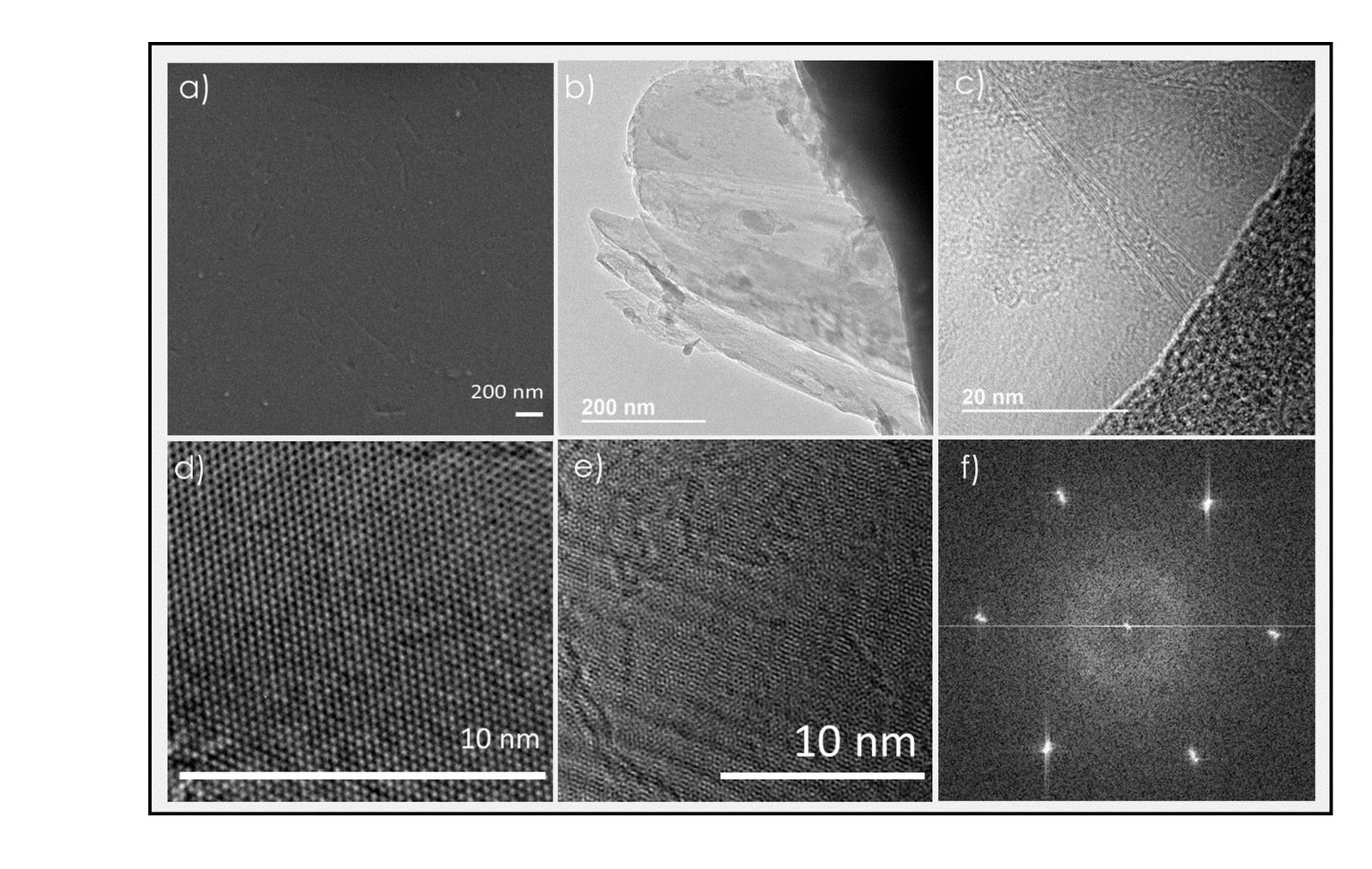
A procedure for the one-step preparation of films of few-layer N-doped graphene on top of nanometric hexagonal boron nitride sheets ((N)graphene/h-BN) based on the pyrolysis at 900 °C under an inert atmosphere of a film of chitosan containing about 20 wt% of ammonium borate salt as a precursor is reported. During the pyrolysis a spontaneous segregation of (N)graphene and boron nitride layers takes place. The films were characterized by optical microscopy that shows a thin graphene overlayer covering the boron nitride layer, the latter showing characteristic cracks, and by XPS measurements at different monitoring angles from 0° to 50° where an increase in the proportion of C vs. B and N was observed. The resulting (N)graphene/h-BN films were also characterized by Raman, HRTEM, SEM, FIB-SEM and AFM. The thickness of the (N)graphene and h-BN layers can be controlled by varying the concentration of precursors and the spin coating rate and is typically below 5 nm. Electrical conductivity measurements using microelectrodes can cause the burning of the graphene layer at high intensities, while lower intensities show that (N)graphene/h-BN films behave as capacitors in the range of positive voltages.
Figures
No figures are reproduced on this page while the source file is being reverified against the final published article.
How to cite
Article access and reuse
The Royal Society of Chemistry states that an author may reproduce figures and diagrams from their own RSC article when correct acknowledgement is given. The local repository file associated with this record does not contain the matching article manuscript after its cover sheet, so it has not been hosted and its extracted graphics have been withheld from this page pending source replacement.
Research fields
Bottom-up
A boron-nitride template dispersed in a polystyrene biomass-derived precursor directs a one-step, catalyst-free pyrolysis route to vertically stacked N-doped graphene-BN heterostructures. The process yields both large-area films and powders rather than isolated microscopic flakes.
Characterization
AFM and electron microscopy measure the stacked morphology, while Raman spectroscopy, XPS, diffraction and fluorescence microscopy verify the coexistence and registry of graphene and BN. Electrochemical tests then connect the accessible heterostructure area with enhanced oxygen-reduction activity.
RESEARCH TOPICS
 MaterialsElectron diffraction measured across the resulting film supports a vertically ordered graphene/BN superlattice rather than a random powder or laterally separated mixture. The comparison is important because electrochemical transport depends on a continuous graphene pathway while BN modifies stacking, spacing and interfacial polarization without acting as a metallic catalyst.
 ChemistryThe heterostructure is produced without a metal catalyst. Using matched chemical components but different stacking lets the experiment associate the changed charge-transfer response with organisation at the graphene/BN interface.