Research · Publication & note
New publication: tunable perovskite memristors for synaptic emulation
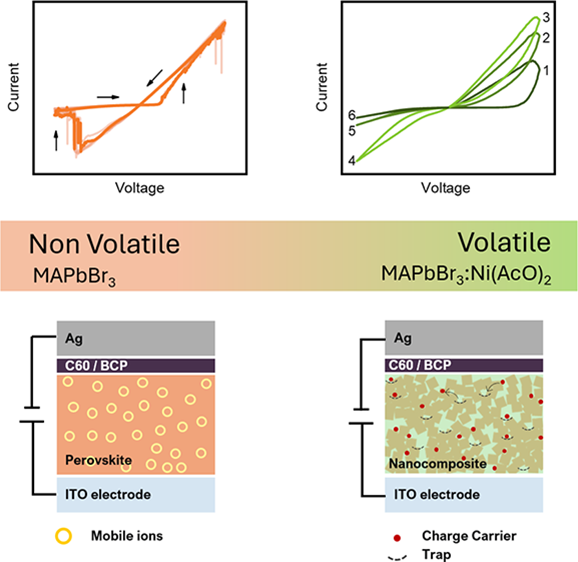
Our new paper, published in ACS Applied Materials & Interfaces, explores a simple way to make perovskite memristors behave more like artificial synapses. By growing MAPbBr3 nanocrystals inside a nickel acetate matrix, we can tune how the devices change their electrical conductance: the abrupt, persistent switching of the bulk material gives way to a gradual response that relaxes over time.
This fading memory is useful for processing information that arrives as a sequence of electrical pulses. The nanocomposite devices reproduce several features of synaptic plasticity, including potentiation, depression and paired-pulse facilitation, while maintaining reproducible operation over 1,000 cycles under ambient conditions. The material is prepared in a single solution-based step, without annealing or a glovebox.
The study also demonstrates a proof-of-concept reservoir-computing task using small, noisy digit patterns. Measured device responses support approximately 89% classification accuracy with a linear readout, rising to about 98% with a deeper nonlinear readout. These results connect the material's short-term memory with neuromorphic computing, while photoluminescence and impedance measurements help explain the role of interfacial charge trapping.