Research · Publication & note
Inducing Tunable Volatile Analog Switching in Nanocomposite-Based MAPbBr3 Perovskite Memristors for Synaptic Emulation - Notes
ACS Applied Materials & Interfaces · Journal article · 22 October 2026
Published abstract
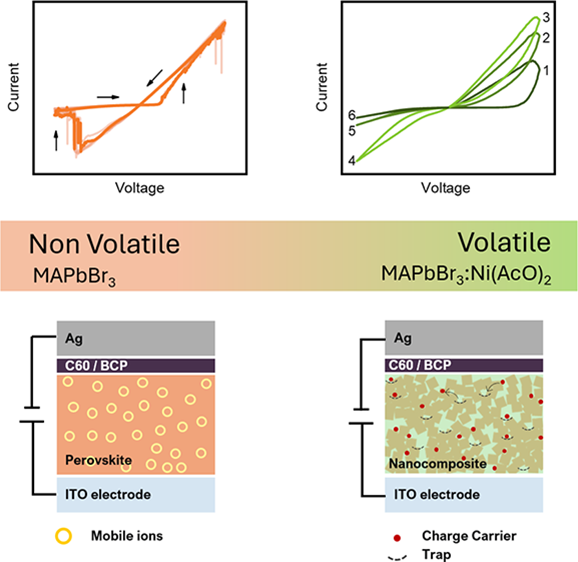
Metal halide perovskites (MHPs) are promising candidates for memristive applications owing to their mixed ionic-electronic conductivity, yet their inherent instability and tendency toward abrupt resistive switching remain critical barriers to neuromorphic implementations. Here, we present a nanocomposite strategy in which MAPbBr3 nanocrystals are synthesized in situ within a nickel acetate matrix through a one-step, annealing-free, and glovebox-free process, enabling ambient-stable memristive devices. By modulating the perovskite volume fraction, the ionic-electronic dynamics are tuned, inducing a transition from abrupt, nonvolatile digital switching in polycrystalline MAPbBr3 to gradual, volatile analog switching in the nanocomposite. Impedance spectroscopy and photophysical analyses attribute this transition to a shift from ion migration-driven switching in the bulk material to interfacial charge trapping and detrapping in the nanocomposite. The resulting volatile memristors emulate key synaptic functionalities, including short- and long-term plasticity, paired-pulse facilitation, and spike-dependent weight modulation, with stable performance over 1000 cycles under ambient conditions. Exploited in a reservoir computing framework, the nanocomposite memristor achieves ∼89% classification accuracy on noisy digit patterns with a linear readout, rising to 98% with a deeper network. This scalable, solution-processed approach offers a viable route to analog memristors for neuromorphic and edge computing.
Figures
P. F. Betancur et al., ACS Applied Materials & Interfaces (2026), DOI: 10.1021/acsami.6c11506. © 2026 The Authors. CC BY 4.0. Extracted from the published PDF and converted losslessly to WebP; figure content unchanged.
P. F. Betancur et al., ACS Applied Materials & Interfaces (2026), DOI: 10.1021/acsami.6c11506. © 2026 The Authors. CC BY 4.0. Extracted from the published PDF and converted losslessly to WebP; figure content unchanged.
P. F. Betancur et al., ACS Applied Materials & Interfaces (2026), DOI: 10.1021/acsami.6c11506. © 2026 The Authors. CC BY 4.0. Extracted from the published PDF and converted losslessly to WebP; figure content unchanged.
P. F. Betancur et al., ACS Applied Materials & Interfaces (2026), DOI: 10.1021/acsami.6c11506. © 2026 The Authors. CC BY 4.0. Extracted from the published PDF and converted losslessly to WebP; figure content unchanged.
P. F. Betancur et al., ACS Applied Materials & Interfaces (2026), DOI: 10.1021/acsami.6c11506. © 2026 The Authors. CC BY 4.0. Extracted from the published PDF and converted losslessly to WebP; figure content unchanged.
How to cite
P. F. Betancur, M. Minguez-Avellan, I. Fernandez-Guillen, J. Noguera-Gómez, F. Ramiro-Manzano, R. Abargues, T. S. Ripolles and P. P. Boix. Inducing Tunable Volatile Analog Switching in Nanocomposite-Based MAPbBr3 Perovskite Memristors for Synaptic Emulation. ACS Applied Materials & Interfaces (2026). Published online 22 October 2026. https://doi.org/10.1021/acsami.6c11506.
Article access and reuse
The article is open access under Creative Commons Attribution 4.0 International (CC BY 4.0). The published abstract and figures are reproduced with attribution to the authors and a link to the original article. Figure files were extracted from the supplied publisher PDF and converted losslessly to WebP; their scientific content is unchanged. The accompanying explanations are author-curated research notes. This online-first record does not yet include volume, issue or page numbers.
Official article and supporting informationResearch fields
Bottom-up
MAPbBr3 nanocrystals are synthesised in situ within a nickel acetate matrix by a one-step, solution-based process at room conditions, without annealing or a glovebox. Varying the perovskite volume fraction changes the crystal population and transport pathways; the 40 vol % composition is selected for detailed memristive characterisation.
Characterization
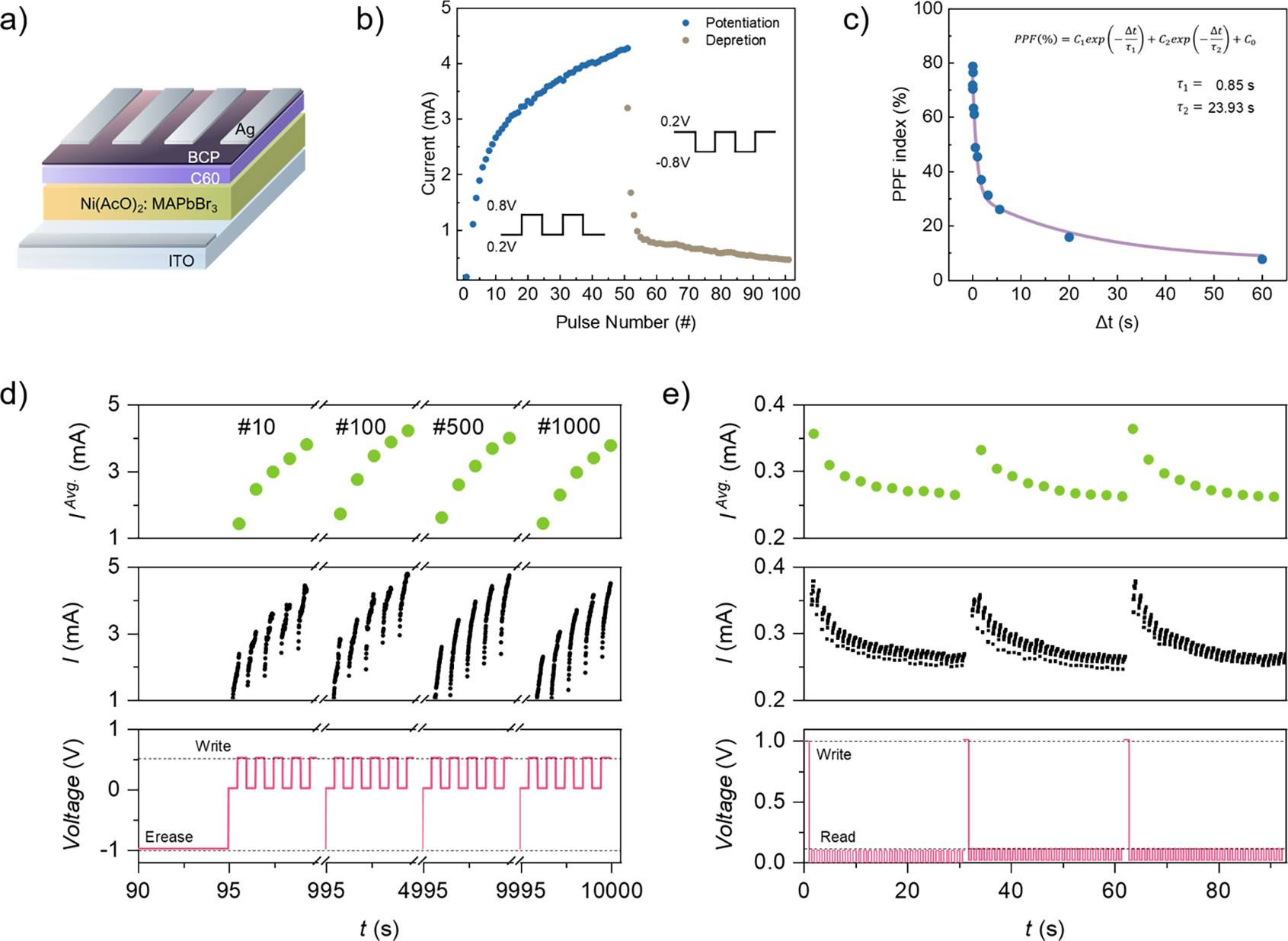
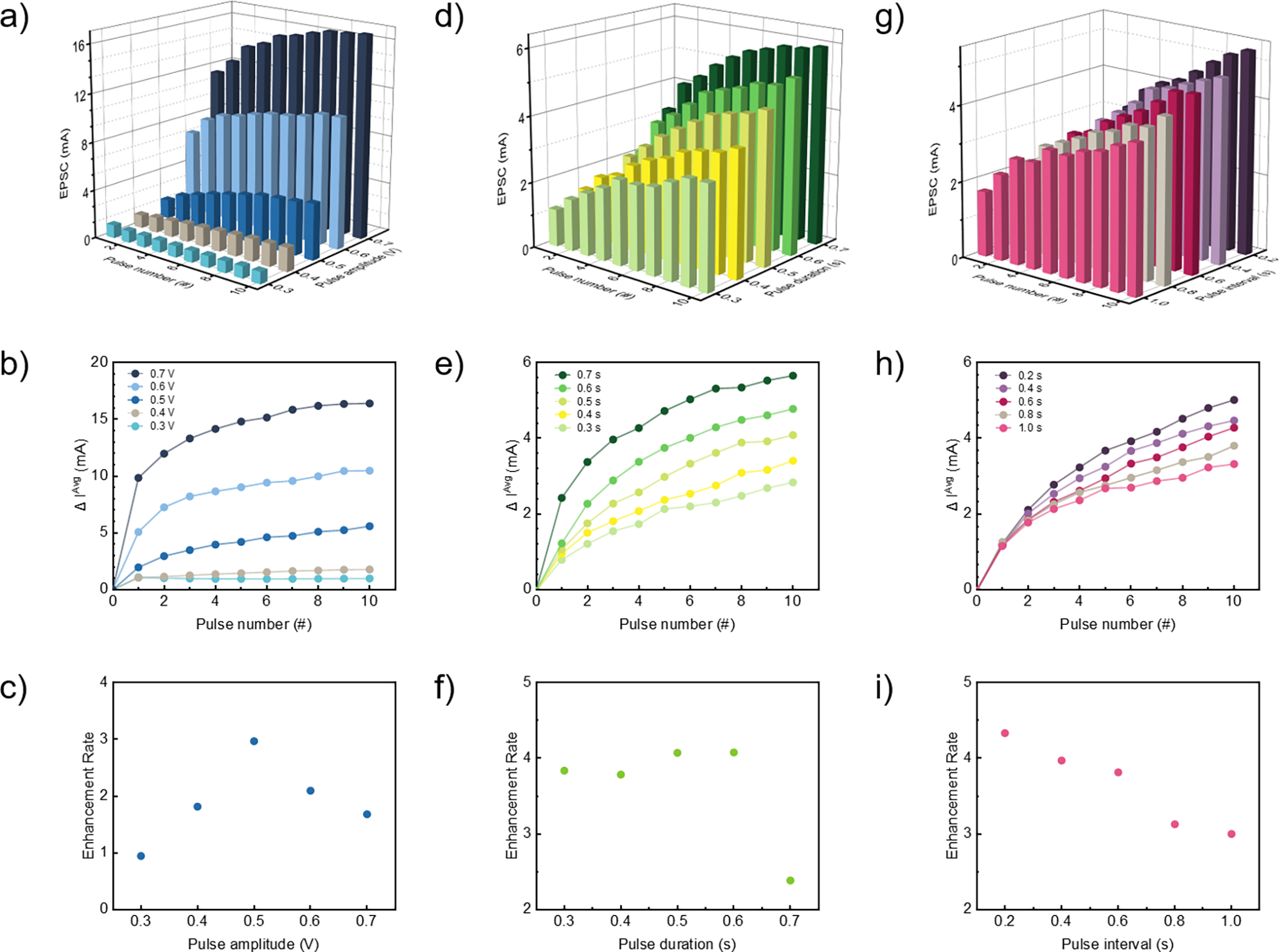
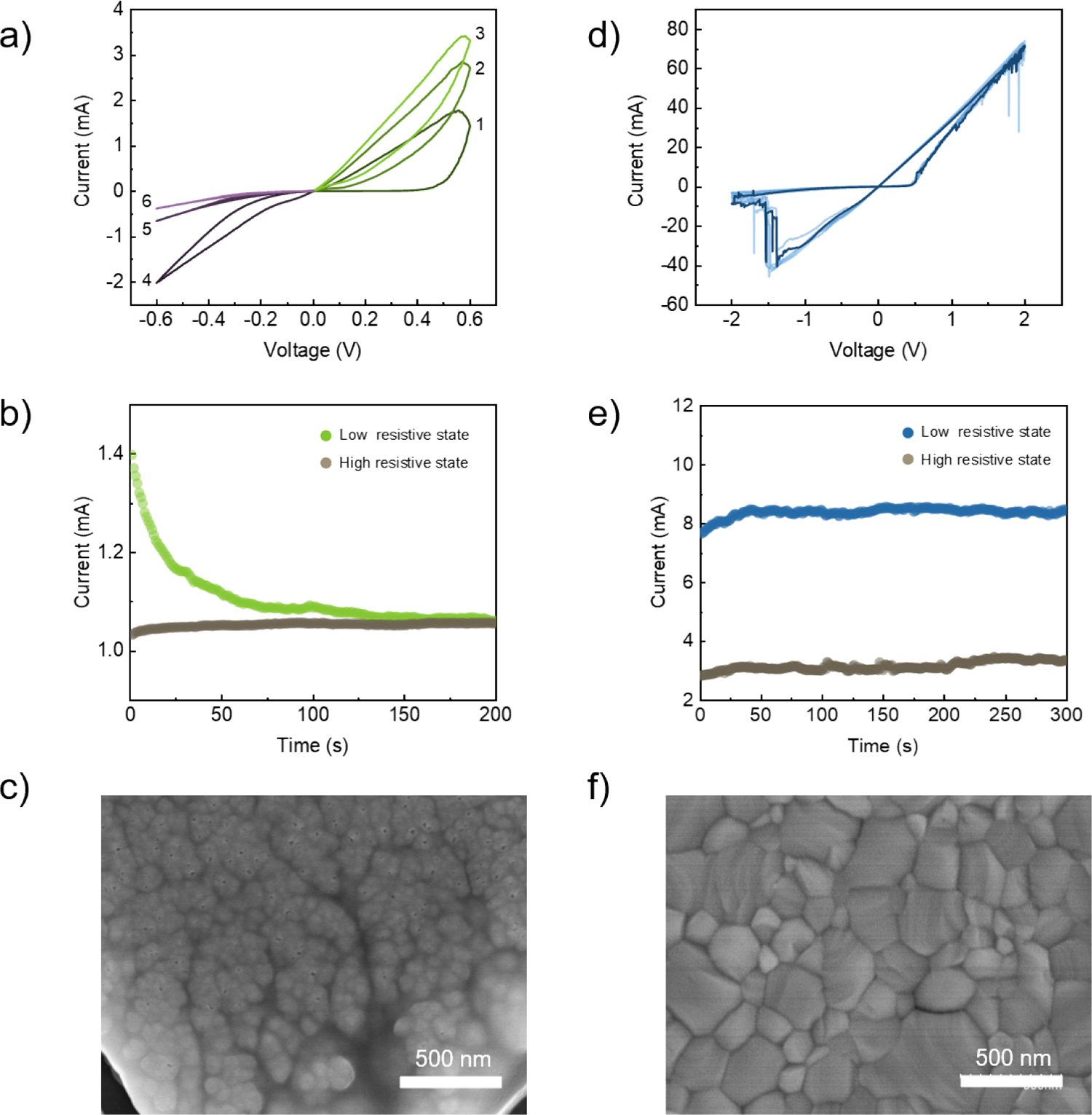
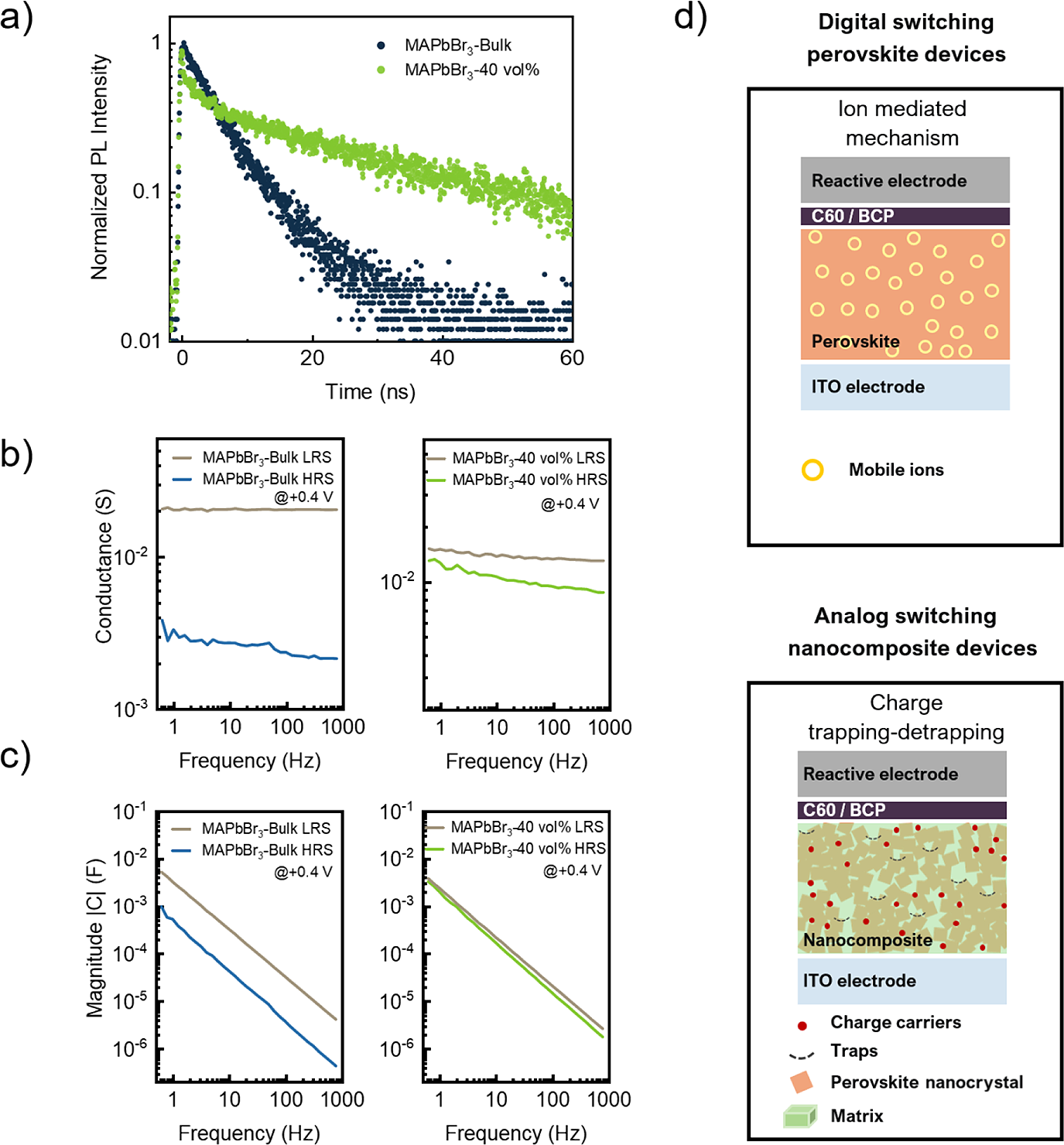
Electrical pulse measurements quantify potentiation, depression, paired-pulse facilitation, retention and cycling endurance. Electron microscopy, time-resolved photoluminescence and impedance spectroscopy connect the nanocomposite morphology and charge dynamics with the transition from abrupt nonvolatile switching to gradual volatile behaviour.
Simulations & fits
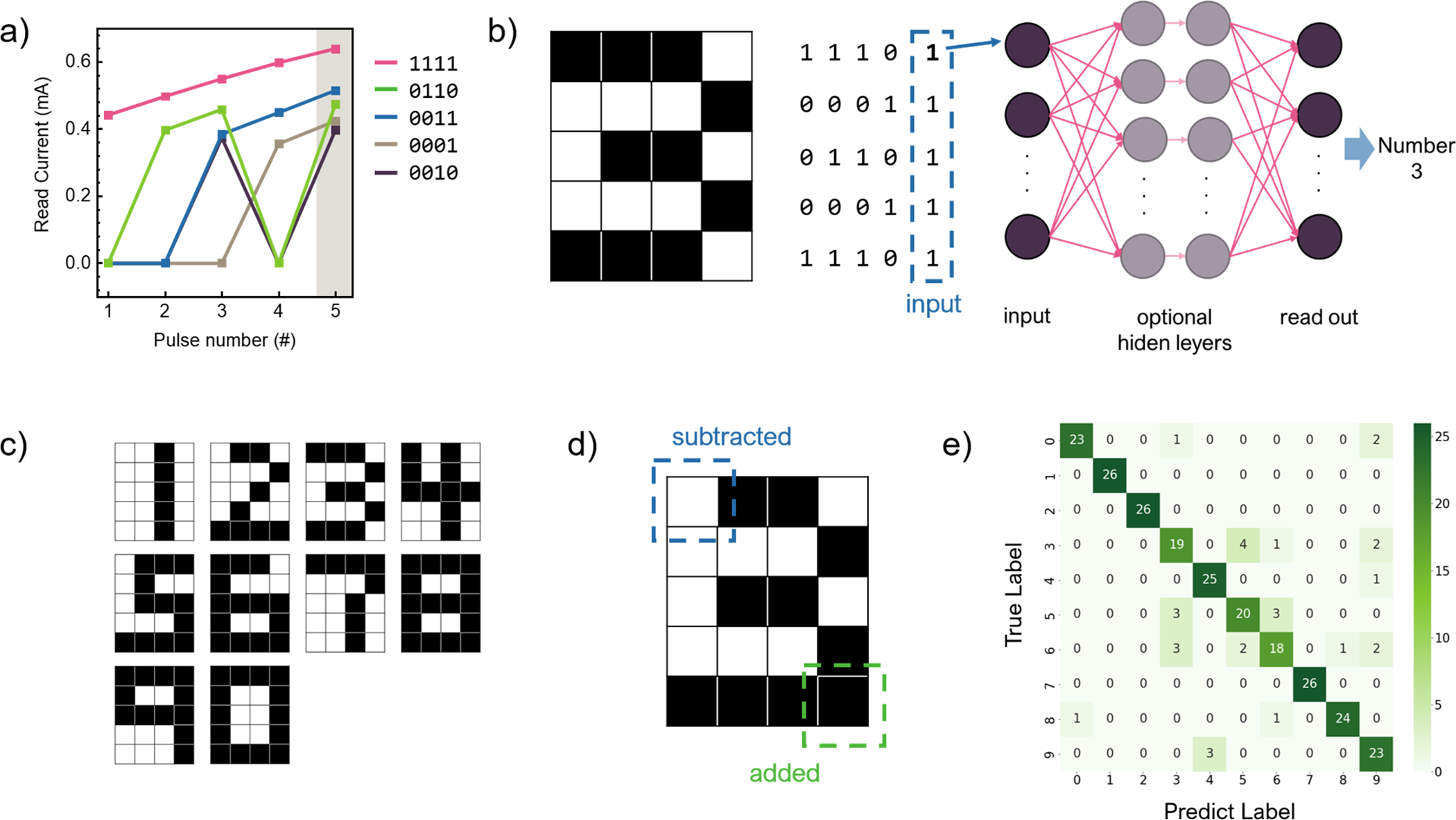
Double-exponential fits quantify the fast and slow relaxation of paired-pulse facilitation. Measured responses to four-bit pulse trains form reservoir states for a proof-of-concept classifier using 5 × 4 pixel digits. A linear readout achieves about 89% accuracy on noisy patterns, while a deeper nonlinear readout reaches about 98%; these are results for the paper's specific benchmark.
Research topics
 MaterialsAt 40 vol % perovskite, the nanocomposite shows gradual, volatile switching rather than the abrupt, persistent states of the bulk film. The material architecture therefore controls both conductance modulation and memory retention.
 ChemistryThe in situ crystallisation process uses precursor concentration and ambient humidity to control nanocrystal growth within the matrix. This offers a simple ambient-compatible fabrication route, while the humidity tests also show that unencapsulated devices remain sensitive to more severe moisture exposure.
 EmissionTime-resolved photoluminescence provides a probe of charge-carrier dynamics. Bulk MAPbBr3 has a nearly monoexponential decay, whereas the composite shows a fast component and a longer-lived contribution.
 AIThe device's fading memory and nonlinear response encode electrical pulse sequences into reservoir states. The latter improvement comes from the classifier architecture, rather than a change in the memristor dynamics.